Forget the Benchmarks. The Real AI Race Is in Daily Cron Jobs
Benchmark season never ends in the American tech press. Every week there is a new chart. Someone is always winning. Someone else is always falling behind.
The more useful conversation is happening somewhere else. It is about what an AI agent actually produces while you sleep.
In June 2026, Nous Research ran a public hackathon. The brief was narrow. Build an agent that completes real business tasks. Not a chatbot. A worker. Something that hands in deliverables when the session ends.
Value lived entirely in what the agent produced. Not how fluently it narrated its reasoning. Did it close the loop? Did the task get done?
The Nous hackathon was asking something different. What is the smallest recurring task you can hand an AI agent? And trust it to run every morning without you.
That question has been quietly producing a different kind of AI user, in a different kind of country. One the benchmark conversation does not assume exists.
The instinct, once someone realizes Hermes can connect to twenty different tools, is to connect all of them at once. Email. Calendar. Slack. A weather service. A trading bot. Three note-taking apps. The result is usually a setup that runs brilliantly for a few days and then silently breaks. An API changed. A prompt hit a context limit.
The more durable pattern, observed across dozens of power users in the months after Hermes launched, is the opposite. Pick one task. Just one. Something that runs every morning at a fixed time. Produces a concrete result. Write it somewhere you will actually look.
A knowledge worker in Shanghai described what worked for her. Every morning at 9:30, Hermes searched three industry feeds. It pulled the five most relevant articles. Saved a formatted summary to Obsidian. She woke up, opened her vault, and read what happened in her field overnight. No browser tabs. No manual search. Just a file.
That does not sound like a revolution. It is on a completely different axis from what the benchmark conversation measures. And once it clicked for her, she could not go back.
Most coverage misses the first cron. It is the hardest to write, not because of technical complexity, but because it forces a precision that casual chat never demands. A prompt like “tell me what happened in my industry” will not survive contact with a scheduled job. Which feeds. What time window. How many sources. What format. Where exactly to save the file. What to do if nothing worth reading appeared that day.
Writing that prompt is the actual work. More like product design than coding.
Once the first cron fires and produces a file that did not exist before, three things shift.
First: the vague becomes precise. The interest in staying informed becomes a workflow. The “I should read more about X” becomes a file that lands in your vault every morning. The moment this happens, AI stops being an experiment and starts being infrastructure.
Second: something starts accumulating. Obsidian stores files locally, in plain Markdown, no subscription required. A week’s worth of automated summaries is a pattern. A month’s worth is an asset. The agent is not answering questions. It is building something that compounds over time.
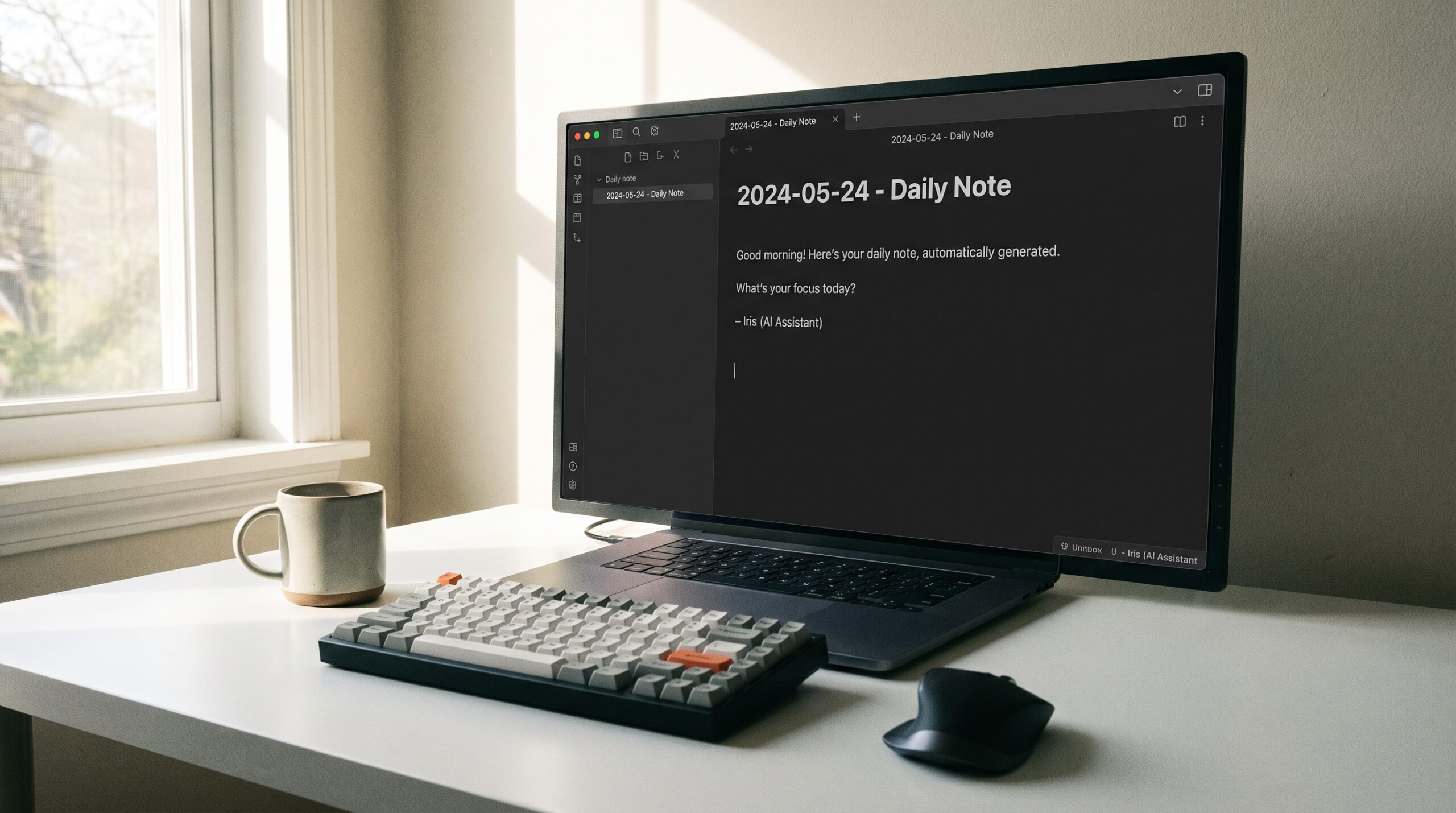
Third and most underappreciated: one reliable cron is the foundation for everything after it. A morning intelligence digest. A meeting prep task that pulls from email before a standup. A daily code commit summary for anyone watching a repository. Each addition takes minutes once the infrastructure is in place.
The systems that try to automate everything on day one tend to automate nothing six months later. The ones that start with one boring reliable task tend to still be running.
What I keep coming back to: the failure mode is almost always ambition. Not technical failure. Ambition. The excitement of what the system could do overtakes the discipline of what it should do first.
Setting up Hermes for the first time takes two commands. The first pulls everything into alignment. Authentication. Model providers. Tool gateway connections for search, image generation, TTS, and browser automation. The second confirms that all services are reachable.
Five minutes. A browser window for OAuth. Then you are in.

From there, writing the first cron prompt trips most people up. The reason is not technical. A cron task in Hermes runs as a fresh session every time it fires. The prompt cannot assume anything from previous conversations. Every instruction, every path, every output format needs to be in the prompt itself.
That sounds like a limitation. It is actually the feature. It forces you to be specific about what you actually want.
The Obsidian connection does not require extra configuration in most setups. Hermes detects the vault path from the environment variable. It reads and writes files directly in plain Markdown. The cron schedule is set at creation time. A task that runs every weekday at 9:30 fires automatically, writes its output, and closes. If the network is down, the session ends cleanly. No partial files.
The benchmark conversation treats AI as a contest between prodigies. The people who have been running daily crons for six months describe something more mundane and more durable.
A tool that shows up. Does the thing it was told to do. Leaves something behind.
Then does it again the next day. And the day after that.
That is not a chatbot. That is closer to an employee, minus the management overhead.
Once you have one running reliably, the question shifts from “what can AI do?” to “what should I stop doing myself?” The second question is harder and more valuable.
The race that matters is not between models. It is between those with an AI running a task before breakfast. And those still reading benchmark comparisons on a Saturday morning.
The advice to start with one cron is obvious in hindsight. But the instinct to start with ten is also completely understandable. The excitement of what the system could do overtakes the discipline of what it should do first. Whether that is a failure of imagination or just human nature is something I have not fully resolved.