
Google AI Studio’s Free Custom URLs: Why the Move Matters
July 10, 2026 marks a quiet revolution inside Google AI Studio. In one move, Google eliminated the last excuse developers had for not shipping their AI apps publicly: the ugly link.
Say goodbye to URLs like burning-man-animal-cuddle-614365371127.us-west1.run.app. Say hello to atelier.ai.studio.
Google AI Studio has officially launched Custom URLs, a feature that lets anyone publish a Gemini-powered app and claim a clean, memorable name.ai.studio address in seconds. No domain registrar. No DNS configuration. No HTTPS certificates. Just a name, a publish button, and four steps.
The official tagline from Logan Kilpatrick’s team says it all:
“Free apps, free deploys, and now free pretty URLs.”
Google’s main account even dropped the classic internet opener: “wake up babe, AI Studio custom URLs just shipped.”
Sound small? It isn’t.
The Last Centimeter of AI App Distribution
For an AI application, the model makes it smart. Cloud Run keeps it alive. But the URL decides whether it ever makes it into a client’s inbox, a colleague’s chat, or an investor’s browser.
A link that looks like a system error code makes people hesitate. A link that reads like a brand makes people click.
Custom URLs solve what Google is calling the “last centimeter” of AI app distribution, the final gap between “it works” and “it’s shareable.”
What You’re Actually Getting (and What You’re Not)
Google’s ai.studio namespace works like an apartment building. The structure, ai.studio, belongs to Google. What you claim is your apartment number. The moment you unpublish, that number goes back to the pool and someone else can claim it.
That means this is fundamentally different from owning yourbrand.com:
name.ai.studio |
Custom Domain | |
|---|---|---|
| How you get it | Claim at publish time | Buy from a registrar |
| DNS and certificates | Handled by Google | Usually manual |
| Brand ownership | Within Google’s namespace | Fully yours |
| Name release | Returns to pool on unpublish | Controlled by holder |
The rules are explicit: global uniqueness, first-come-first-served, released back to the public pool the moment an app is unpublished or deleted. Trying to move a catchy name from an old app to a new one? You have to release it first, and during that window, someone else could grab it.
So “permanent” means: as long as your app stays published, the address stays yours. That is not the same as owning domain rights.
The process to claim one is genuinely four steps:
Build mode > Publish > Fill in Custom URL > Publish App
Google handles the HTTPS certificates and all underlying configuration backstage.
The Machine Behind the Curtain Is Still Cloud Run
The pretty address is just the storefront. Underneath, your app still runs on Google Cloud Run, a container hosting service that removes the need for developers to maintain their own servers.
Before this update, swapping in a custom brand domain required navigating Google Cloud Console, adding Domain Mapping, verifying ownership with TXT records, and configuring A, AAAA, and CNAME records. Each step made sense on its own. Together, it was a DNS dance.
In December 2025, Google AI team member Paige Bailey published a dedicated tutorial just to walk users through mapping a Namecheap domain to Cloud Run. Back then, “pretty URLs” was still a cloud operations task.
Seven months later, Google folded the entire process into a single input box.
That is where productization gets powerful: the technology disappears, and only the outcome remains.
The Free Tier Has Fine Print
Google is not handing out unlimited free cloud. The official deployment comes in two tiers.
The Google Cloud Starter Tier allows up to two full-stack app deployments without requiring a separate Cloud project or billing account, but services are confined to a single Cloud Run region. Once the two slots are used, you either delete one or upgrade.
There is also a catch that is easy to miss: users who already have or have previously had an active Google Cloud billing account, or are associated with a paid or free Google Workspace organization, are not eligible for the Starter Tier.
Full production-scale usage requires connecting AI Studio to a billed Google Cloud project through Standard Deployment.
So yes, the pretty URL is free. But free production infrastructure still has quotas and eligibility boundaries.
The Name Grab Is On, and the Ghost of 2009 Is Back
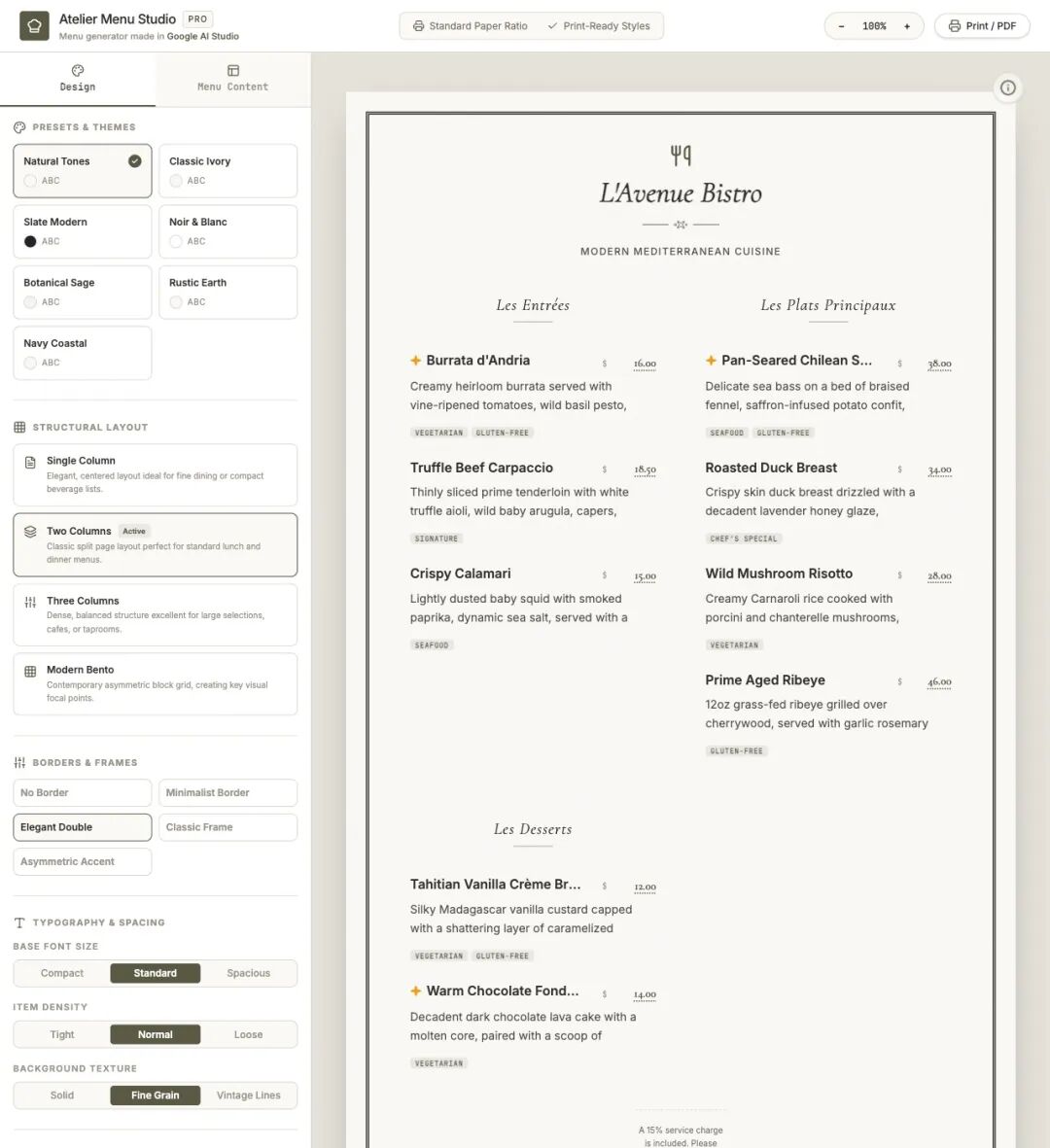
On launch day, Google put a menu generator live at atelier.ai.studio, the left side adjusts themes and layouts, the right side generates restaurant menus in real time. It does not look like a model experiment. It looks like a product you could hand to a client today.
DeepMind’s Sam Sheffer claimed samsheffer.ai.studio. AI Studio’s product and design lead Ammaar Reshi published ammaar.ai.studio and playfully called on others in the comments: “can you visit my website plz.”
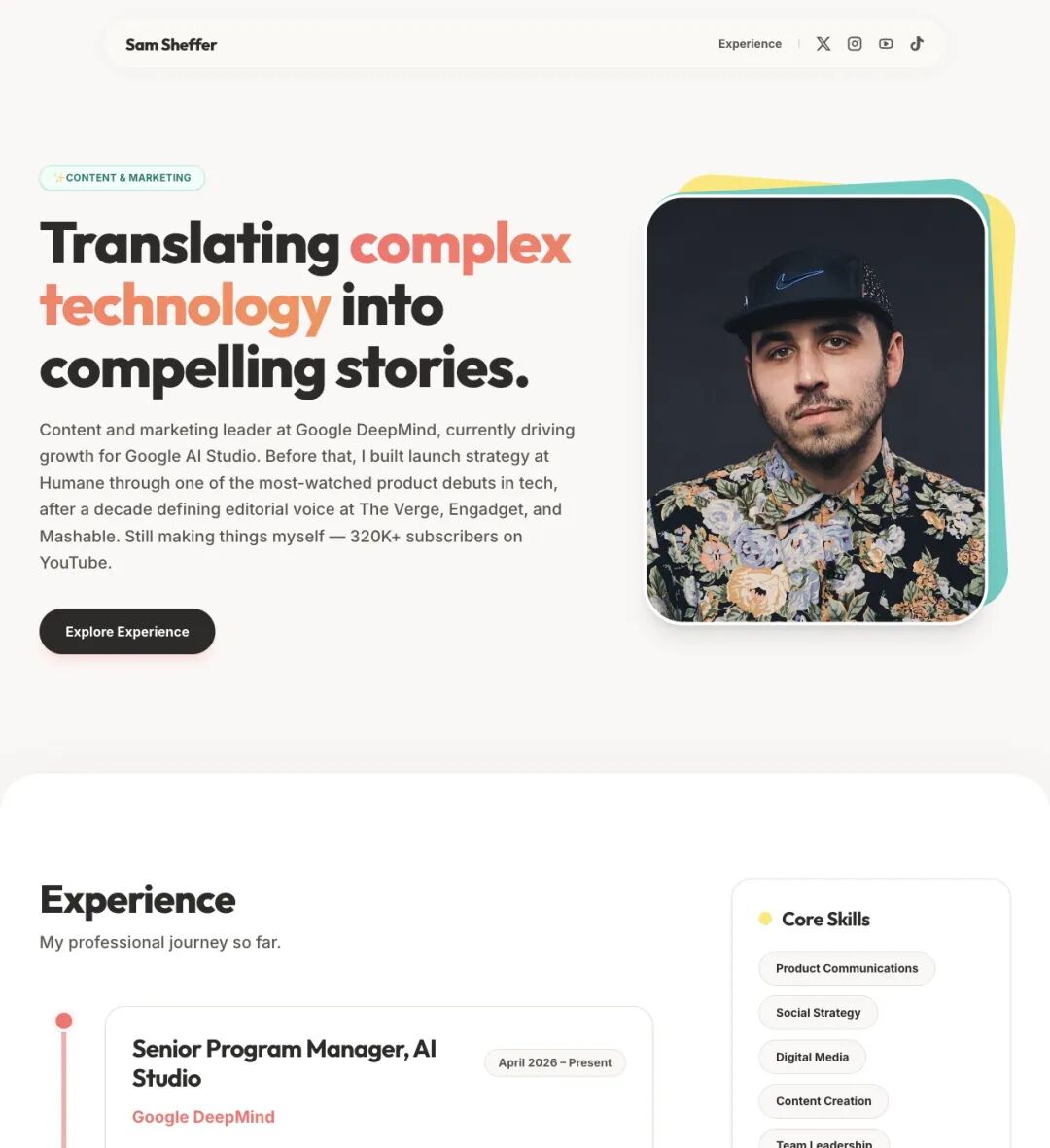
Google employees are already using their names as personal brand pages.
TestingCatalog noted the resemblance to 2010s Google Websites. The comments section went further: dropping an AI-generated agent on a Google subdomain felt like returning to GeoCities in 2009.
History seems to loop. From free homepages to blog subdomains to today’s AI apps, the internet keeps making the same trade: the platform removes deployment friction, and you temporarily house your identity in the platform’s namespace.
The difference this time: instead of dragging components block by block, you can say to Gemini, “build me an app.”
AI Studio Is No Longer a Prompt-Testing Playground
Custom URLs were not shipped in isolation. Roughly two days prior, AI Studio Build added support for importing GitHub repositories. Before that came Design Variations, chat history sharing, and the Interactions API for model and agent orchestration.
Put the pieces together and the roadmap is clear:
Code in > AI modifies > UI variants > One-click deploy > Readable URL > Share with the world
Google is repositioning AI Studio from “a place to test prompts” to a complete AI-native application production surface.
This update sidesteps parameters, benchmarks, and the usual “intelligence leap” narrative. But it may more directly shift developer behavior. Many promising demos never reach users because of friction in the publishing process, ugly links, and the recipient’s hesitation to click an address that looks like a server hiccup.
The Hidden Risk: Prettier Links Attract More Attention
Memorable URLs drive more traffic. More traffic amplifies problems that were previously hidden in a corner.
If an API key is embedded in the frontend. If call limits are not set. If a public app can be hit with unlimited requests from strangers.
A viral pretty link can become a runaway billing invoice overnight.
Google has not committed to permanent ownership of name.ai.studio addresses, and public documentation lacks a comprehensive reserved word list or a long-term SLA. For trademark and copyright disputes, Google provides a legal reporting channel. But first-come-first-served does not mean permanent ownership.
The Practical Playbook
For hackathons, classrooms, demos, and internal tools: use ai.studio first, it is as fast as flipping a switch.
For long-running, officially branded products: purchase a custom domain early, control your DNS, brand, and migration path.
Before going public: protect your keys, set usage limits, and configure budgets.
Google did not make Gemini smarter this time. It turned a string of machine-generated gibberish into a name that can be read aloud, written down, and forwarded without apology.
Platform wars sometimes pivot in unexpected places. One day, an ordinary person builds an app, taps once, and owns the address to a live piece of the web.