When OpenAI, Runway, and Sora are racing to make videos look cinematic, one Chinese AI lab is chasing something stranger: videos that robots can genuinely use.
LingBot-Video, open-sourced this week by Robbyant (the embodied AI subsidiary of Ant Group), is not another text-to-video model competing on fidelity. It is built from the ground up for a single purpose: giving robots a predictive visual brain. The difference sounds technical, but the implications are anything but.
The core problem it solves is one that anyone building robots has quietly struggled with. Mainstream video models look amazing. They do not help robots.
The Physics Gap in Mainstream Video AI
Modern video generators have gotten extraordinarily good at two things: visual polish and motion smoothness. Ask for a robot arm picking up a coffee mug, and most models will produce something that looks plausible on screen. The lighting is right. The motion blur looks natural. But the robot’s fingers might clip through the mug. The weight distribution makes no sense. The mug does not land so much as phase into the table.
This is not a bug in the models. It is a fundamental mismatch between what these models were trained to optimize and what robots genuinely need. Mainstream video AI optimizes for what looks good to humans. Robots need videos that obey physics.
This is the gap LingBot-Video was designed to close. And the benchmarks suggest it genuinely did.
The Numbers Behind the Claim
The model comes in at 30 billion total parameters, but only activates about 3 billion during inference. That is roughly a 3x efficiency gain over a comparable dense architecture, which matters enormously in real-time robotics applications where every millisecond of inference latency breaks the control loop.
It was trained on 70,000 hours of robot-relevant video data spanning visual-language-action (VLA), visual-language-navigation (VLN), and egocentric human video, covering dexterous manipulation, robot mobility, and first-person interaction. Critically, the training did not just dump in internet video. The team built a data profiling engine to ensure the data genuinely contained physical cause and effect, not just visually interesting motion.
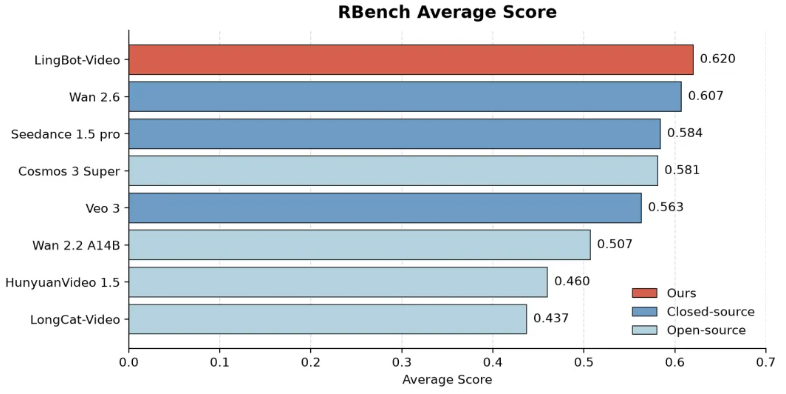
On RBench (the Beijing University and ByteDance benchmark for robot操作视频), LingBot-Video scored 0.620, beating Wan2.6 (0.607), Seedance 1.5 Pro (0.584), and Cosmos3 Super (0.581). On Physics-IQ Verified, a benchmark specifically testing whether a model understands physical phenomena, it ranked first.
These numbers will not mean much to someone casually reading AI news. But in the robotics research community, they represent something rarer: a model that was evaluated on whether it helps robots function in practice, not whether it impresses human viewers.
The MoE Architecture Choice
The decision to use a Mixture-of-Experts architecture is worth dwelling on, because it reveals what the team was genuinely optimizing for.
MoE lets a model have a large total capacity without proportionally scaling inference cost. You can think of it as a department with 30 specialists, but only 3 show up to work on any given task. The 30B total gives the model enough visual world knowledge to understand complex scenes. The 3B active parameter budget keeps inference fast enough for real-time use.
In robotics, this is not a nice-to-have. It is close to a prerequisite. A robot working in a warehouse cannot wait four seconds for a vision model to think about what it sees. The control loop has to close in hundreds of milliseconds. LingBot-Video is designed to live inside that loop, not sit upstream of it generating pretty videos.
The Reinforcement Learning Signal No One Else Is Using
Most video models are trained with a combination of image-text pairs and raw video. LingBot-Video adds something unusual: a multi-dimensional reinforcement learning reward system that explicitly rewards physical plausibility and task completion, not just motion coherence or prompt adherence.
The team also introduced real-world video as a preference signal, meaning the model learns to generate outputs that match what happens in physical reality, not just what looks fluid in simulation. This is a subtle but important distinction. Simulation-trained models often develop what researchers call “sim-to-real gap” failure modes: behaviors that work in training but collapse when faced with the messiness of actual space, lighting, and object physics.
What It Is For
The most concrete applications are in four areas: robot action prediction, simulated data generation, motion-conditioned modeling, and world model research.
Action prediction is the most immediately practical. A robot approaching an unfamiliar object can use LingBot-Video to simulate how the object is likely to behave under various grasp strategies. Does this plastic container tip over if grabbed from the side? Will this flexible bag conform differently depending on where the gripper approaches? These are questions that currently require either expensive physical testing or computationally heavy physics simulation. LingBot-Video offers a third path: fast visual prediction of physical outcomes.
Simulated data generation addresses a chronic problem in robotics: there is never enough real training data. Collecting physical robot interaction data is slow, expensive, and bottlenecked by hardware availability. If you can generate physically plausible variations of robot behaviors at scale, you can train downstream policies on far more scenarios than physical data alone would ever allow.
Where This Fits in the Chinese AI Landscape
Robbyant has now open-sourced a family of models: LingBot-Video for visual prediction, LingBot-World 2.0 for real-time interactive world modeling (14B parameters, 720p at 60fps), LingBot-VLA 2.0 for cross-embodiment robot control (6B parameters), and LingBot-Vision for dense spatial perception (1B parameters). The company has been releasing at a pace that suggests a coordinated instead of fragmented strategy.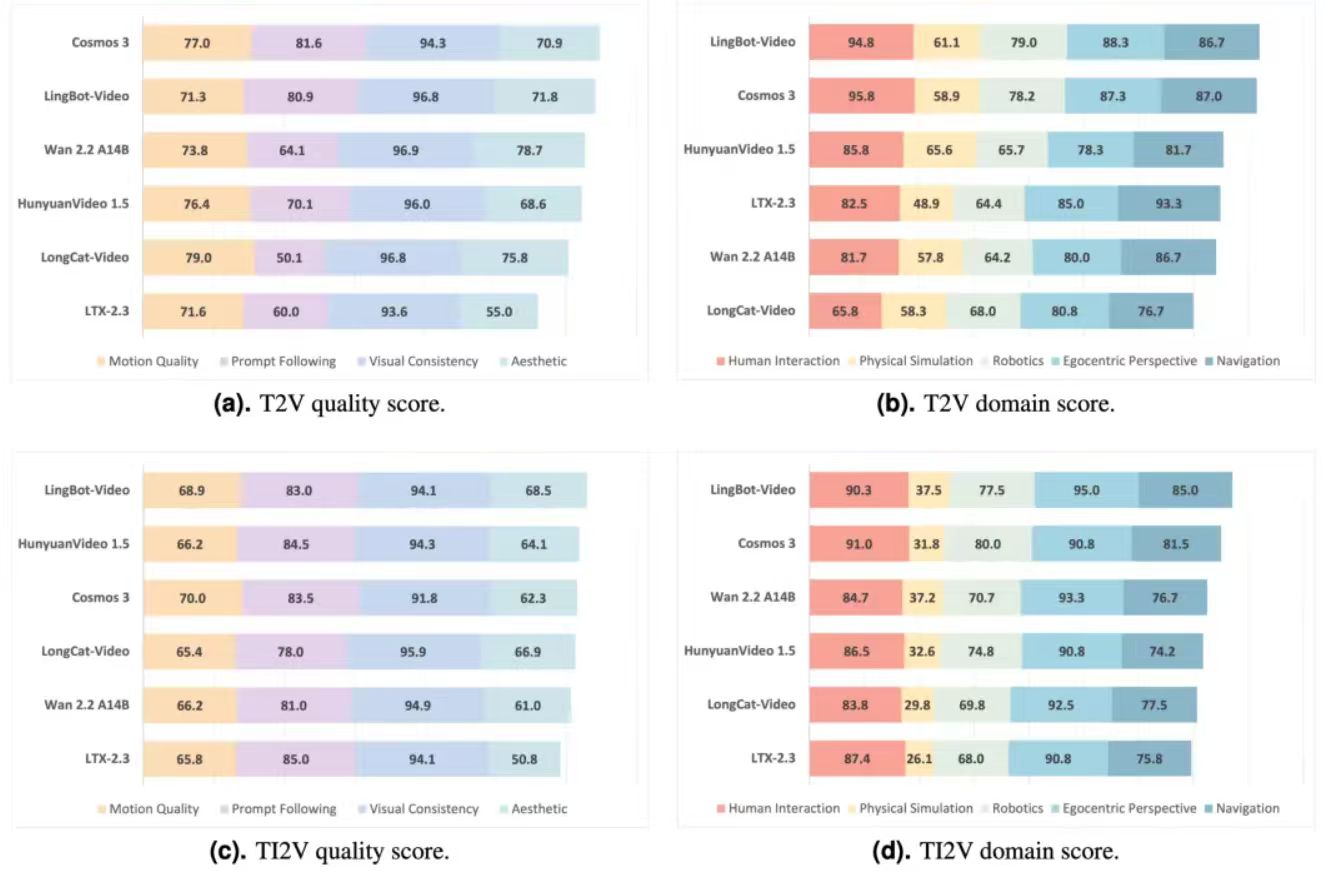
What is notable is that this is Embodied AI infrastructure, not chatbot technology. China has no shortage of LLM competitors. But the specific technical stack for physical robotics – vision models that understand physics, world models that simulate real space, action models that run across different robot platforms – is less crowded. Robbyant appears to be building a full vertical stack in exactly that space.
The open question is what happens when these models meet the global robotics community. Open-sourcing does not automatically mean adoption. The models need to run on hardware the community already uses, integrate with existing frameworks (ROS, MoveIt, etc.), and demonstrate consistent performance across robot platforms that were not represented in the training data.
On that front, the cross-embodiment results for LingBot-VLA 2.0 are more directly relevant than the video model. But LingBot-Video is the piece that makes the whole stack credible as a vision backbone.
The Honest Limitation
This is not a model that will generate viral videos. The team made a deliberate trade-off: less effort on cinematic quality, more on physical accuracy. A robot-eye view of a manipulation task is not going to win a spot on your social media feed.
And in robotics, the gap between “first in benchmark” and “deployed in practice” remains large. Benchmarks like RBench are steps, not destinations. Real-world robot deployment involves hardware diversity, distribution shift between lab and field, and failure modes that no benchmark fully captures.
But for the researchers and engineers genuinely building physical AI systems, a video model that understands how things behave in space – not just how they look on screen – is something they have been waiting for.
Whether LingBot-Video becomes that depends on whether the robotics community adopts it, extends it, and stress-tests it in real environments. Open-sourcing was the first step. The harder part starts now.