The New Benchmark That Separates Real AI Coding Agents From Demos
TL;DR
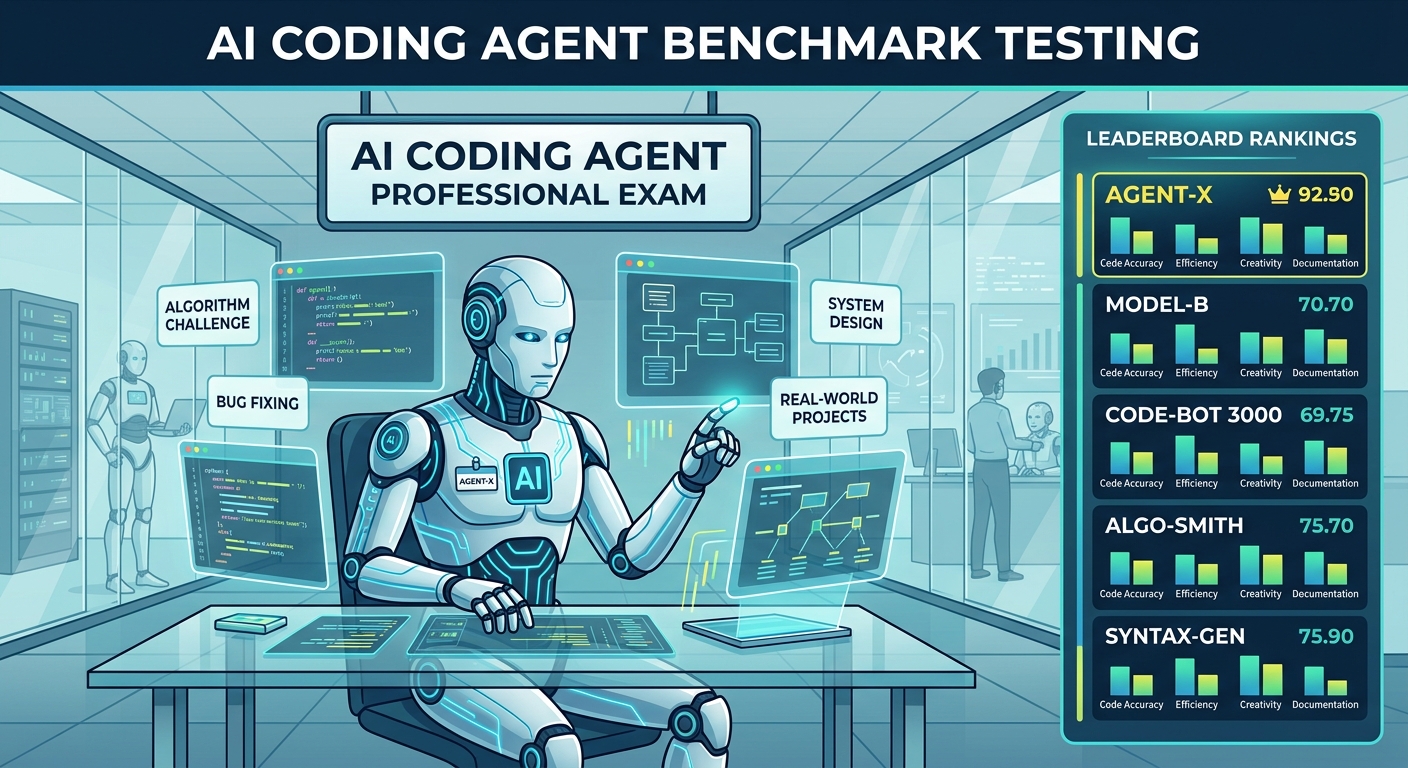
There’s a new leaderboard for AI coding agents — and it measures something different than most benchmarks. Human Bench tests agents on realistic professional tasks, not curated puzzles. The current leader: Righthand (American Productivity Company), using Claude Sonnet 4.6, scoring 84%. What makes this benchmark different, and why it might matter more than any single benchmark you’ve seen before.
Most AI Benchmarks Are Useless
Here’s the problem with most AI coding benchmarks: they’re designed to be easy to measure, not representative of real work.
SWE-bench tests AI on real GitHub issues. It’s the most credible coding benchmark. But it only measures one thing: can the agent fix a documented bug or implement a documented feature?
What it doesn’t measure: whether an agent can triage an ambiguous problem, track down a bug that isn’t clearly documented, maintain context across a long task, or know when to ask a human instead of guessing.
Real professional work is messy. Most benchmarks are clean.
What Human Bench Does Differently
Human Bench describes itself as “the benchmark for agents that work in the real world.” The key difference is in how tasks are selected and evaluated:
Realistic professional tasks — not puzzles, not canned problems, but tasks that reflect what developers actually do. The benchmark is designed to capture the gap between “can solve a documented issue” and “can do productive professional work.”
Human-evaluated outcomes — the evaluation isn’t an automated test pass/fail. The benchmark looks at whether the task was actually completed correctly, which requires human judgment in ambiguous cases.
Model-agnostic — any agent can be submitted. The leaderboard shows results across different models and agent architectures, which makes it possible to compare approaches, not just providers.
The Current Leaderboard (June 2026)
| Rank | Agent | Org | Model | Score |
|——|——-|—–|——-|——-|
| 01 | Righthand | American Productivity Company | Claude Sonnet 4.6 | 84.0% |
| 02 | (scores pending) | — | — | — |
The leaderboard is new and sparse. This isn’t a mature, crowded benchmark like MMLU or HumanEval. It’s an early-stage effort to measure something harder to quantify.
But the direction matters: the benchmark community is starting to acknowledge that demo-quality performance on synthetic tasks doesn’t translate to professional usefulness.
Why 84% Is Actually Impressive
84% on realistic professional tasks sounds lower than typical benchmark scores (which often claim 90%+). But it’s measuring something harder.
Consider: if you gave a junior developer a set of realistic professional tasks and they completed 84% correctly on their first attempt, you’d hire them immediately. That benchmark score reflects actual task completion, not whether the agent passed a curated test suite.
The harder question is what the remaining 16% represents. For professional use, the answer matters:
– Ambiguity, the agent couldn’t resolve — tasks where the agent should have asked a human, but tried to guess
– Context: the agent couldn’t find information that existed in the codebase, but the agent couldn’t locate it
– Edge cases the agent missed — reasonable-sounding solutions that happened to be wrong in this specific case
Those failure modes are exactly what make AI coding assistants frustrating in practice.
What This Means for Tool Selection
If you’re choosing an AI coding assistant in 2026, most vendor benchmarks won’t help you much. They measure what vendors want to show, not what users actually need.
Human Bench is early. It doesn’t have the coverage to be definitive. But it’s pointing at the right question: not “can the agent pass this test” but “can the agent do useful professional work.”
The practical implication: prefer tools that publish realistic task performance data, not just benchmark scores. And pay attention to whether the tool acknowledges its failure modes — a tool that tells you where it struggles is more trustworthy than one that only shows its best results.
Focus Keyword
`Human Bench AI coding agent`, `AI coding agent benchmark 2026`, `best AI coding assistant comparison`, `coding agent leaderboard`, `AI developer tools benchmark`
Tags
AI coding agents, benchmark, Claude Sonnet, AI developer tools, coding AI, AI performance, AI productivity, agent evaluation