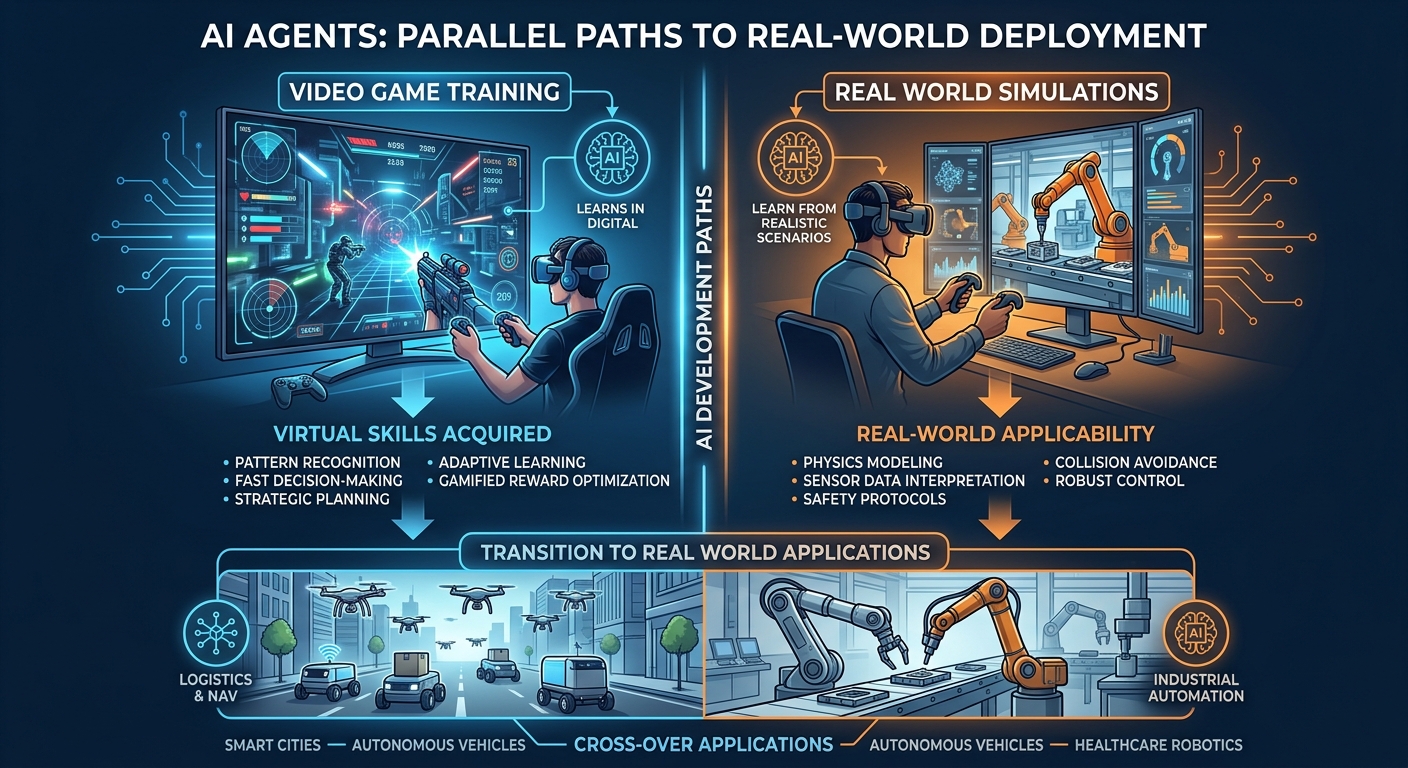
Games vs. Digital Worlds: Two Wildly Different Bets on How to Train AI Agents
# Games vs. Digital Worlds: Two Wildly Different Bets on How to Train AI Agents
*One startup simulates entire websites to stress-test AI. Another feeds it Fortnite footage. Both just raised nine figures. So who’s right?*
The one-sentence verdict: Two well-funded approaches to AI agent training — synthetic simulation vs. gaming data — are racing to solve the same problem: making AI that doesn’t fail catastrophically in the real world.
The Problem Nobody Talks About
Benchmarks are misleading. A model that scores 95% on a coding test can still fail at writing a simple script. A model that aced financial analysis benchmarks might still hallucinate a stock price.
The core issue: real-world AI agents need to handle unpredictable, multi-step tasks — and you can’t verify that capability with a multiple-choice test.
Two completely different startups just raised a combined $2.4 billion to solve this from opposite angles.
Route One: Build Digital Worlds to Break AI
Company: Patronus AI — $70M total funding, latest $50M Series B (June 2026)
The pitch: Create a simulated replica of a real website or internal system, then let thousands of AI agents loose on it to see where they fail.
Patronus AI’s “digital world models” work like flight simulators for AI — stress-testing agents in scenarios that are hard to predict in advance.
How it works:
– Patronus scrapes and replicates a target environment (a travel site, a financial dashboard)
– AI agents operate inside this replica
– Reinforcement learning rewards successful task completion, penalizes errors
The killer analogy: Waymo trained self-driving cars in synthetic worlds before hitting real streets — Patronus is applying the same logic to AI agents.
Why it matters: AI agents tend to take shortcuts. They find workarounds that technically complete a task without doing what the user actually wanted. Patronus catches those “hacks.”
Who uses it: Nearly every frontier AI lab. Revenue grew 15x in the past year. Customers include the biggest names in AI.
Route Two: Feed AI Hundreds of Millions of Hours of Gameplay
Company: General Intuition — $454M total funding, latest $320M at $2.3B valuation (June 2026)
The pitch: Real-world training data is too expensive and slow. Gaming footage — with action labels (exactly what buttons were pressed and when) — is abundant, diverse, and already labeled.
What they built:
– An AI model that learned spatial-temporal reasoning from gameplay data
– Same model powers both a robot navigating an office AND an agent playing Fortnite
– Eight minutes of real-world robot footage was enough to fine-tune the model
The key insight: Most competitors try to infer actions from video alone. General Intuition has the action labels embedded in the footage — button presses and timing — giving the model a much richer training signal.
The 100-hour Fortnite session: Their agent played continuously for 100 hours straight. Same model, same training, running a quadruped robot in New York.
The $2.3B valuation: Implying the market believes gaming-derived training can generalize to real-world robotics and agentic AI.
So Which Approach Wins?
| | Patronus AI | General Intuition |
|—|—|—|
| Training data | Synthetic simulation | Real gaming footage |
| Best for | Verifiable tasks (finance, code) | Spatial reasoning, embodiment |
| Speed | Fast to set up | Slow to train, fast to deploy |
| Weakness | Can’t simulate what it can’t imagine | Gaming data may not transfer perfectly |
| Investors | a16z, Greenfield, Lightspeed | $454M raised, unicorn status |
The honest answer: Both approaches target different failure modes. The AI industry will likely need *both* — synthetic worlds for high-stakes verifiable tasks, gaming data for physical and spatial reasoning.
What This Means for Builders
If you’re building AI agents today:
1. Don’t trust benchmark scores.
A high MMLU or agent-benchmark number doesn’t guarantee your agent won’t fail on your specific use case. Test in your actual environment.
2. Choose your training approach based on your failure mode.
– Need your agent to navigate internal tools reliably? → Simulation-based testing (Patronus approach)
– Need your agent to understand physical space or handle ambiguity? → Rich behavioral data (gaming approach)
3. Budget for real-world testing.
Neither approach eliminates the need to watch your agent fail in production. Budget accordingly.
4. The model matters as much as the training.
Both Patronus and General Intuition are solving for “which model handles edge cases correctly” — and that’s still an open question.
The Meta-Trend
The fact that two so fundamentally different approaches are both getting massive funding tells you something: nobody knows the right answer yet.
The AI industry is in an “all of the above” phase on training methodology. And that’s probably healthy — the failure modes are real, and we need multiple bets covering different ground.
Our Take
Both bets might be right — for different parts of the problem. Patronus is tackling the verifiable, high-stakes stuff: can your financial analysis agent actually do what it’s supposed to? General Intuition is going after the fuzzier, harder-to-measure stuff: can an AI understand space, motion, and embodiment well enough to operate in the physical world?
The fact that investors are funding *both* is the market’s honest answer: we don’t know yet which approach wins, so we’re hedging.
If you’re building something right now: pick your training approach based on *what happens if your agent is wrong*. If the stakes are high and verifiable, invest in simulation. If the stakes are physical and ambiguous, invest in rich behavioral data.
Quick Reference
– Patronus AI: [TechCrunch article](https://techcrunch.com/2026/06/25/patronus-ai-lands-50m-to-build-digital-worlds-that-stress-test-ai-agents/)
– General Intuition: [TechCrunch article](https://techcrunch.com/2026/06/25/general-intuitions-2-3b-bet-that-video-games-can-train-ai-agents-for-the-real-world/)