Un-0: The AI Image Generator That Uses 1000x Less Energy Than GPUs
The 1,000x Energy Claim That’s Hard to Ignore
The AI industry has a dirty secret: running large models is catastrophically energy-intensive. GPT-4 class models consume megawatt-hours per day. Data centers devoted to AI are straining power grids worldwide. The assumption has been that this is the price of progress.
A company called Unconventional AI just published a paper that challenges that assumption directly — and they’re making their claims concrete with open-source code.
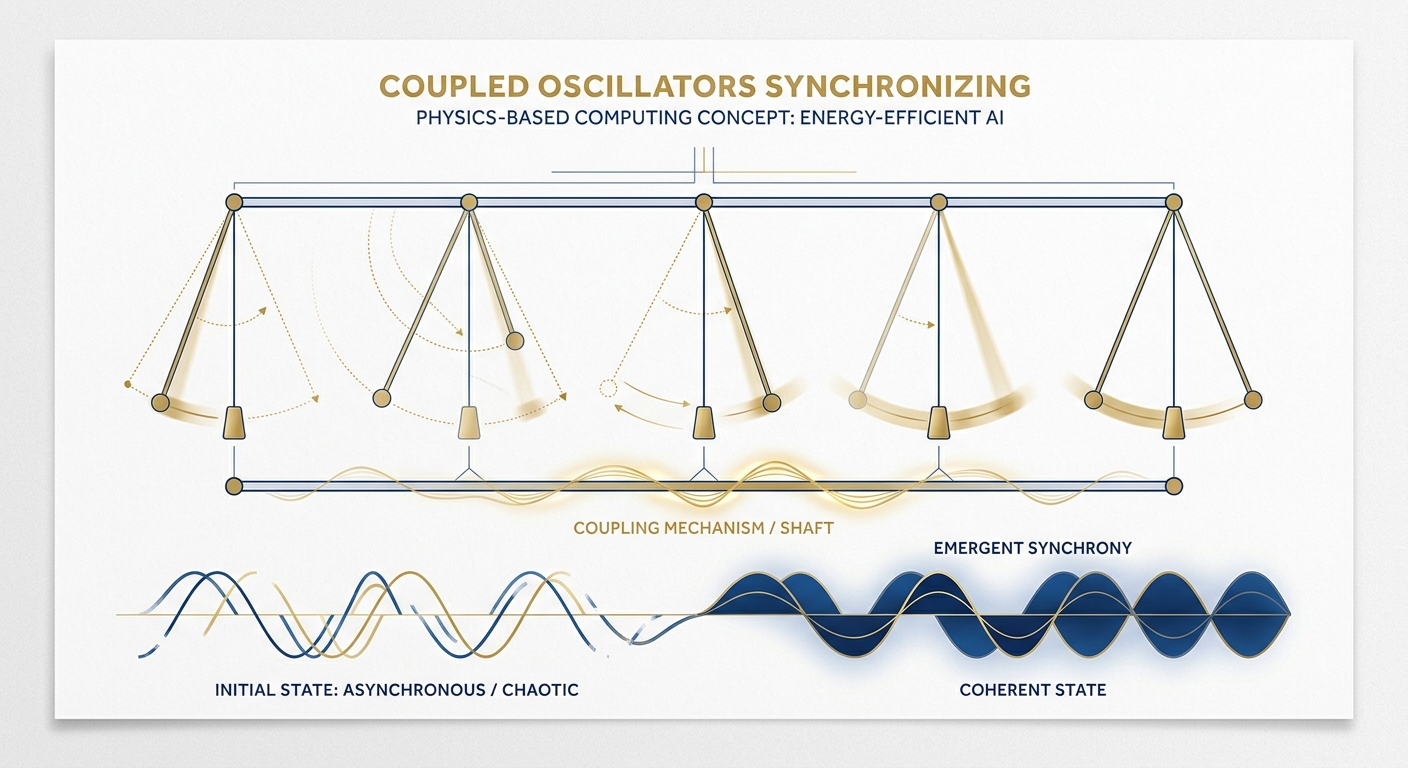
Their new image generator, Un-0, generates images using a fundamentally different computing substrate: coupled oscillators, a system of synchronizing physical dynamics, instead of the matrix multiplication that powers every major AI model today.
The headline claim: 1,000x less energy than GPU-based AI.
What Un-0 Actually Is
Un-0 is an image generator built on a simulated system of coupled oscillators — think metronomes on a shared surface gradually synchronizing their timing. Unlike conventional AI models that run on GPUs performing billions of matrix multiplications per inference, Un-0 computes by simulating physical dynamics.
On ImageNet 64×64, Un-0 reaches FID 6.74. For context: that’s roughly matching where leading conventional image generation methods were when they were first published. It’s not frontier-level quality — yet — but it’s a meaningful proof of concept.
The architecture is explicitly inspired by a long line of physics-based computing research:
– Neuromorphic computing (Mead, 1990)
– Hopfield networks (1982)
– Reservoir computing (2001)
– Liquid networks (2021)
– Hamiltonian networks (2019)
Un-0 scales these approaches to a meaningful benchmark for the first time.
The Founder’s Background
This isn’t a pure research paper from academia. The company was founded by the former AI director at Databricks. That context matters: this is someone who spent years at the intersection of enterprise AI infrastructure and research, and decided the GPU paradigm wasn’t the endgame.
The fact that they’re open-sourcing everything — model weights, training code, ablation studies — signals genuine scientific confidence, not a stealth startup trying to build IP moats before anyone understands what they’re doing.
The Technical Core: Why Oscillators Compute
The intuition behind Un-0 is surprisingly tactile. Imagine two metronomes on the same table. Each has a phase — the angle of its arm at any moment. Put them close together and they influence each other’s timing through the shared surface. Depending on the coupling strength, they drift, synchronize, or lock into anti-phase.
Now scale that to thousands of coupled oscillators, each governed by the same differential equations. The system’s dynamics encode information in the pattern of synchronization. The “computation” is just the physics of the system settling — no matrix multiplication required.
This is fundamentally different from how transformers work. A transformer “thinks” by running gradient descent through massive matrix operations. Un-0 “thinks” by letting a physical system settle into its natural attractor state.
What Hacker News Said (153 points, 36 comments)
The community response to Un-0 was notable — not the breathless hype you’d see for a new foundation model, but genuine technical excitement mixed with skepticism.
The positive reactions focused on:
– The energy efficiency angle being “the right problem to be working on”
– Open-sourcing everything as a sign of genuine scientific contribution, not a funding play
– The interpretability advantage — oscillator dynamics are far easier to analyze than transformer attention patterns
The skeptical reactions:
– 64×64 ImageNet is a far cry from the 1024×1024 generation capability of modern models
– Whether the approach scales to higher resolution is an open question
– “1000x less energy” is comparing an image generator to a full frontier model — the comparison needs more specificity
– The FID benchmark, while decent, isn’t competitive with modern diffusion models
The community consensus: genuinely interesting, early-stage, worth watching, not a GPU killer yet.
Why This Matters Beyond the Benchmarks
Even if Un-0 never generates a photorealistic 1024×1024 image, the underlying approach points to something important: the GPU may not be the final form factor for AI compute.
The history of computing is full of examples where a specialized substrate replaced general-purpose hardware for a specific workload — DSPs for signal processing, ASICs for Bitcoin mining, neuromorphic chips for sparse sensor data.
AI’s energy problem is real and getting worse. As AI inference grows to billions of queries per day, the economics of “physics does the computing” become increasingly compelling.
Unconventional AI isn’t claiming they’ve solved this. They’re claiming they’ve demonstrated it can work in principle, at small scale, and they’re handing the keys to the research community to see if it can be pushed further.
The Honest Assessment
Where Un-0 is impressive:
– Genuine architectural novelty, not a Variational Autoencoder rebrand
– Open-source everything — rare and valuable for this type of research
– The energy efficiency thesis is directionally correct even if the 1000x number is cherry-picked
– Founded by someone with real infrastructure experience, not a first-time founder chasing a trend
Where Un-0 has real limitations:
– 64×64 ImageNet generation is not competitive with Stable Diffusion, DALL-E 3, or Midjourney
– The approach needs to show it scales — nobody has demonstrated this working at modern resolution
– The “1000x less energy” claim is comparing an image generator to a frontier language model — a narrow comparison
– No deployed product, no API, no clear commercialization path yet
The bottom line: Un-0 is a fascinating early result in physics-based computing for AI. It won’t replace GPUs tomorrow. But it’s the most capable demonstration yet that alternative computing substrates for AI aren’t just theoretical — they’re starting to produce real results.
If you’re working in AI hardware, energy-efficient inference, or novel compute substrates, Un-0 is worth a serious look. For everyone else, file it under “things to watch in 3-5 years.”
SEO Fields:
– Title: Un-0: The AI Image Generator That Uses 1000x Less Energy Than GPUs
– Meta: Former Databricks AI director built an image generator using coupled oscillators instead of GPU matrix multiplication. Un-0 reaches FID 6.74 on ImageNet 64×64 and just open-sourced everything.
– Keywords: Un-0, Unconventional AI, physics-based AI, coupled oscillators, energy efficient AI, neuromorphic computing, alternative AI hardware
– Category: AI Tool Reviews
– Slug: un-0-ai-image-generator-physics-computing