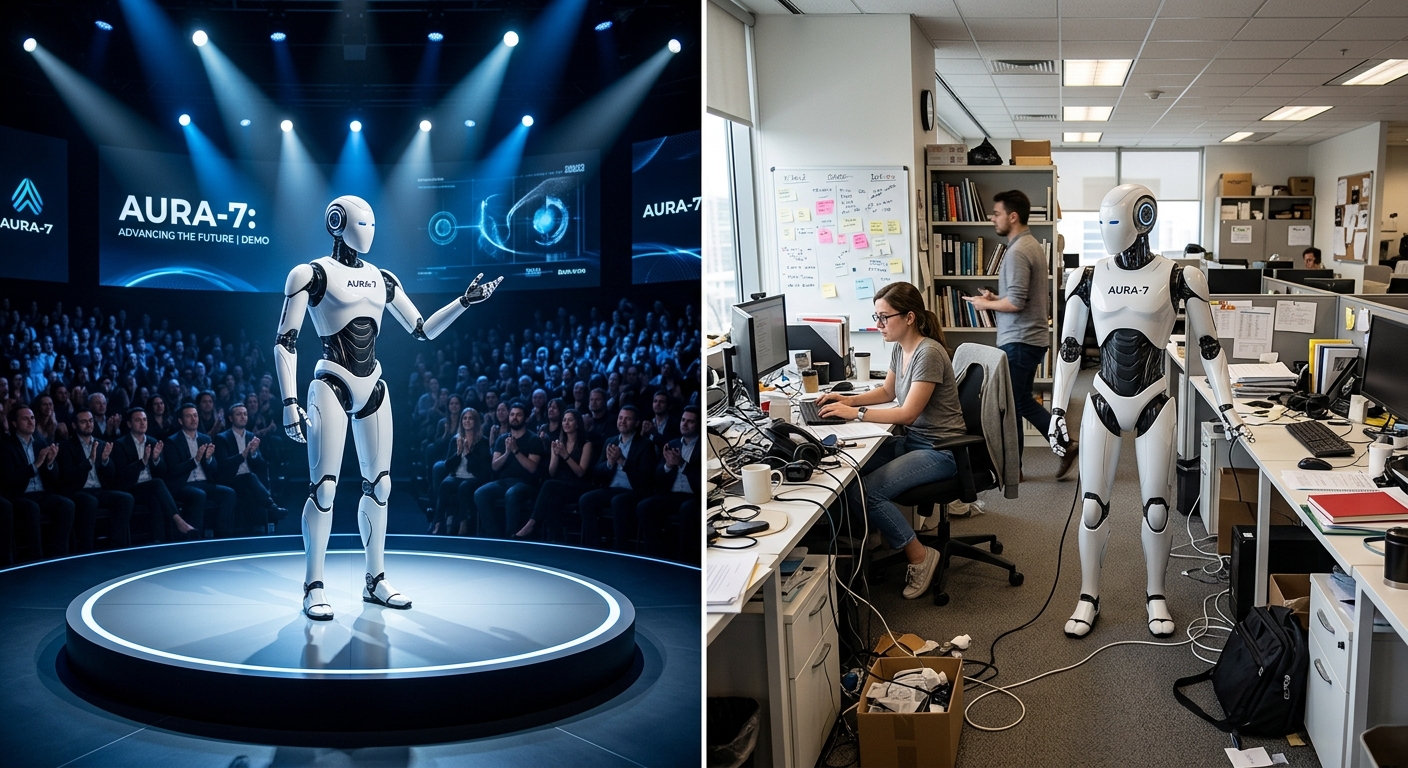
Why Every AI Demo Sounds Amazing and Every Real Deployment Falls Flat
Every AI product you’ve seen demoed looks incredible. Every AI product you’ve actually used in the real world has failed you in some embarrassing way. One developer building an AI receptionist for small businesses put it plainly on Hacker News: “The gap between what AI can do in a controlled demo versus messy real-world phone calls is eye-opening.” Here’s why this keeps happening — and what to actually do about it.
The Gap Nobody Talks About
There’s a running joke in the AI industry: the gap between a demo and production is where AI projects go to die.
A founder posted exactly this in an Ask HN thread titled “Why does every AI demo sound perfect but real-world deployment always disappoints?” Working on an AI voice assistant for small businesses, they described the experience of building a product that sounds amazing in a slide deck and falls apart when real customers actually use it.
The responses from other developers were illuminating:
“That’s the story of almost every product ever.”
Fair point. But AI seems uniquely prone to this problem.
Why AI Makes It Worse
Standard software products have demo-to-reality gaps, too. AI amplifies three specific problems:
### 1. Context windows collapse in production
Demos run on curated data. Real customers feed the AI transcription errors, background noise, accents, incomplete sentences, and mid-sentence topic changes. The model that felt magical in a controlled environment hits a wall when a caller mutters, “uh, um, can you — actually, wait, before I forget — what’s the address again?”
### 2. Caller behavior is unpredictable
In a demo, you control what people say. In production, you get:
– Callers who ramble for three minutes without making a point
– Background noise from kitchens, cars, and construction sites
– People who hang up and call back immediately
– Accents the model wasn’t trained to handle well
– Callers who speak at 200 words per minute
No product manager captures all of these in the demo environment.
### 3. Trust is a real problem
Users know they’re talking to an AI. Some immediately try to exploit it — asking in different ways, testing the boundaries, deliberately provoking errors. Others get frustrated the moment the AI doesn’t immediately understand them and demand a human.
Demos don’t capture the trust dynamics.
What Developers Are Actually Seeing
One commenter who’s been shipping AI voice products put it this way:
> “Because the caller is not experienced with the options or how to execute them correctly. We know how the automated system works. But the caller is just angry if they don’t get a human.”
This is the crux of the AI receptionist problem. The AI sounds great when the interaction is clean and the user cooperates. It falls apart the moment the interaction gets messy — which in customer service, is most of the time.
The Market Reality
One commenter made a cynical but probably accurate observation:
> “The market is more important than the product. Even if the product itself is ordinary, if you get traffic through hype, you will have a source of income.”
This explains why demos keep being polished: the demo is the product. The actual product is secondary.
For buyers, this means: always ask for a production reference, not a demo. Talk to an actual customer using the product in real conditions, not a curated walkthrough.
What Actually Helps
Developers who’ve shipped AI to real customers shared what actually works:
Get real users in early. One suggestion: let a limited number of users actually use the product for free, then let the market write honest reviews instead of relying on polished demos.
Design for failure. Every AI product will fail in unexpected ways. Build for graceful degradation — what happens when the AI doesn’t understand? How does it hand off to a human? Those failure modes matter more than the happy path.
Test with adversarial users. The people most likely to push your AI to its limits aren’t friendly customers — they’re frustrated users trying to get something done despite your product, not because of it.
The Honest Take
The demo-to-production gap isn’t unique to AI. But AI makes it worse because:
– Demos show the best possible output; AI quality is inherently variable
– Real-world inputs are messier than demo scripts
– User behavior in production is adversarial in ways demos don’t capture
– Trust dynamics create friction that scripted demos never reveal
If you’re evaluating an AI product — or building one — the takeaway is simple: never make a decision based on a demo. Push for production references. Talk to real users. Test it yourself on your actual use case, not the use case the vendor prepared for you.