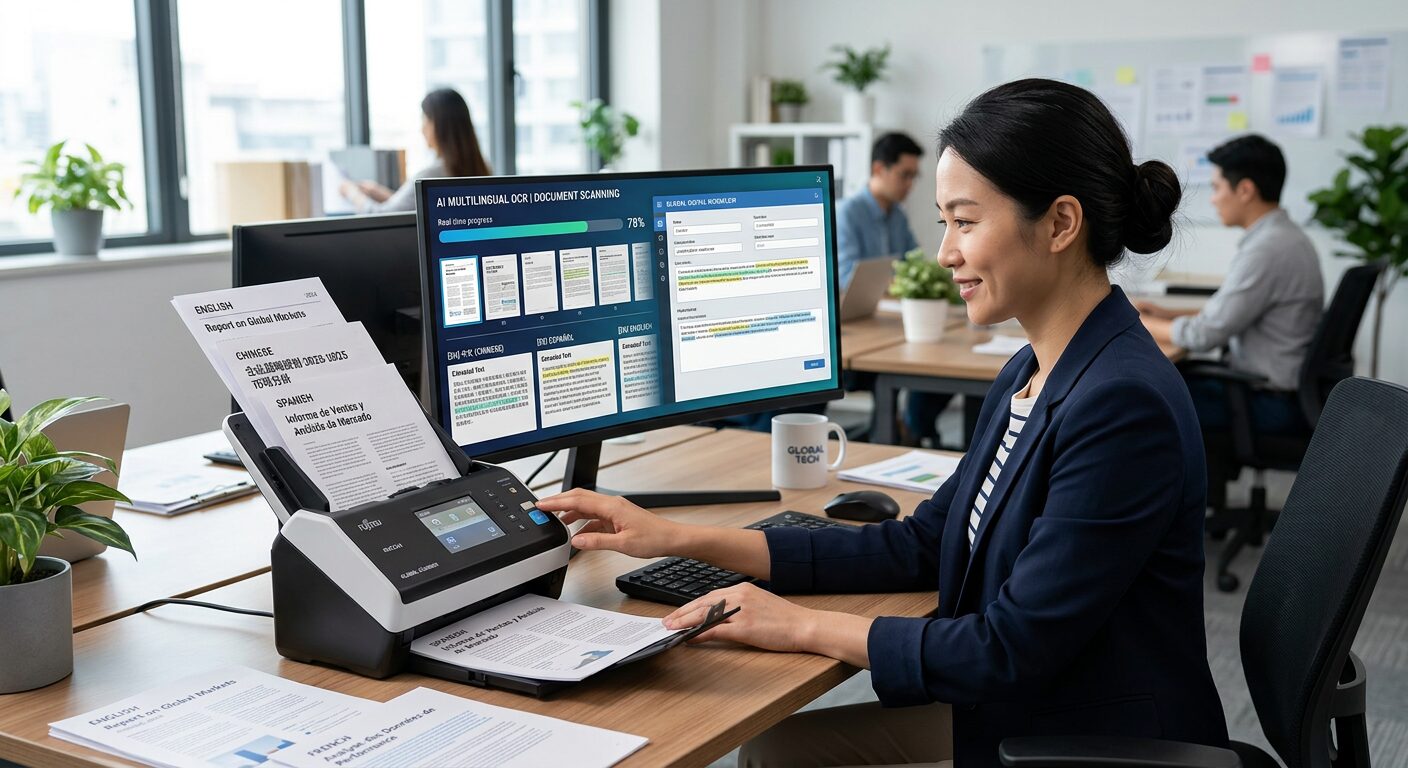
Mistral OCR 4 Handles 170 Languages — Here Is the Self-Hosted Option That Actually Matters
OCR is one of those problems nobody talks about until it breaks.
If you’ve tried to extract text from documents in languages outside the English-French-Spanish set, you know what I mean. The commercial tools either refuse to handle them or handle them badly. Mistral OCR 4 handles 170 languages out of the box. That’s the headline. It’s also most of the story.
The output is what actually matters for building pipelines. Bounding boxes for every text element. Block type classification — header, paragraph, table, signature. Confidence scores per region. You get structure, not just text. For anyone who’s had to build a document processing workflow from scratch, that granularity is nothing. Structured output is the difference between ‘we extracted some text’ and ‘we extracted data we can actually use.’
The self-hosted container is the part that matters for regulated industries. Healthcare providers, law firms, government agencies — they can’t send documents to external APIs. Data residency requirements don’t have exceptions for good OCR. A containerized, self-hosted model removes the blocker entirely. It also requires actual technical comfort to deploy and maintain. If you need Kubernetes experience to deploy it and Kubernetes experience to run it reliably at scale, that’s not a trivial requirement. This is a tool for teams that already have infrastructure capabilities.
170 languages cover a lot of ground nobody else wants to touch. Languages with fewer digital resources. Immigration documents. Legal paperwork. Financial records from markets the big cloud providers never prioritized. That’s the actual customer here — not the English-only Fortune 500 use case that everyone assumes they’re building for.
Google Document AI and Amazon Textract have had years to refine their models. They have deep cloud integrations, they have established enterprise sales cycles, they have the trust of IT departments that have been using their ecosystems for years. For English workloads at scale, they probably still have an accuracy edge. Mistral’s advantages are the language coverage and the self-hosted option for organizations that can’t route documents through a third-party API due to data residency rules.
The fine-tuning angle is the one I keep coming back to. Open weights mean you can train on your specific document types. An insurance company processing claim forms might get substantially better results from fine-tuning on their particular layouts than from any general-purpose model. A government agency working with immigration paperwork could tune performance for specific document formats that no commercial OCR provider is optimized for. That’s the kind of customization the incumbents don’t make easy.
Where Mistral OCR 4 still struggles: highly stylized fonts will challenge it. Degraded documents too. Handwritten text is a different problem entirely — that’s a separate model class and always will be. Mistral is honest about this. Not all the way honest, but honest enough that you can make an informed decision about whether it’s the right tool for your document types.
The price question is the one I keep thinking about. Cloud OCR pricing at scale adds up fast. When you’re processing millions of documents a month, per-page costs compound into meaningful line items. Mistral is likely cheaper for the multilingual use case where the big providers charge premium rates. How much cheaper, and whether it matters enough to justify switching — that’s a calculation worth running if your document volume is anything serious.
The self-hosted pricing model also matters here. One-time compute costs versus per-page API costs create different incentives at different scales. For a company processing ten thousand pages a month, API pricing makes sense. For one processing ten million, the math on self-hosted infrastructure starts to look different.