Skip to content
AIForker

AI Tools, Tutorials, and Insights。

AIForker

AI Tools, Tutorials, and Insights。

  • Home
  • AI Tool Reviews
  • AI Guides
  • AI Agent
    • Codex
    • Hermes
    • Openclaw
    • Claude Code
    • Gemini
  • China AI
    • DeepSeek
    • GLM
    • Qwen
    • Doubao
    • MiniMax
    • Seedance
    • Kimi‌
    • iFLYTEK Spark
  • AI Prompts
  • About Us
  • Home
  • AI Tool Reviews
  • AI Guides
  • AI Agent
    • Codex
    • Hermes
    • Openclaw
    • Claude Code
    • Gemini
  • China AI
    • DeepSeek
    • GLM
    • Qwen
    • Doubao
    • MiniMax
    • Seedance
    • Kimi‌
    • iFLYTEK Spark
  • AI Prompts
  • About Us
  • https://www.facebook.com/
  • https://twitter.com/
  • https://t.me/
  • https://www.instagram.com/
  • https://youtube.com/
Home/AI Tool Reviews/DBOS Review: A Workflow Engine That Runs on Postgres Instead of Custom Infrastructure
AI Tool Reviews

DBOS Review: A Workflow Engine That Runs on Postgres Instead of Custom Infrastructure

By Forker
June 26, 2026 2 Min Read
0
Updated on June 29, 2026

If you’ve worked on microservices that need to coordinate multi-step processes — validate a payment, then send a receipt, then update inventory, then notify the user — you’ve probably encountered Temporal. It’s a workflow engine that makes complex flows traceable, retryable, and observable. The problem is that Temporal requires running its own separate infrastructure: its own runtime, its own event store, its own message queue. For larger teams with dedicated DevOps support, that’s manageable. For smaller teams, it’s a non-starter that pushes people toward less robust solutions or just building their own ad-hoc retry logic that eventually becomes its own problem.

DBOS is trying to solve that with Postgres.

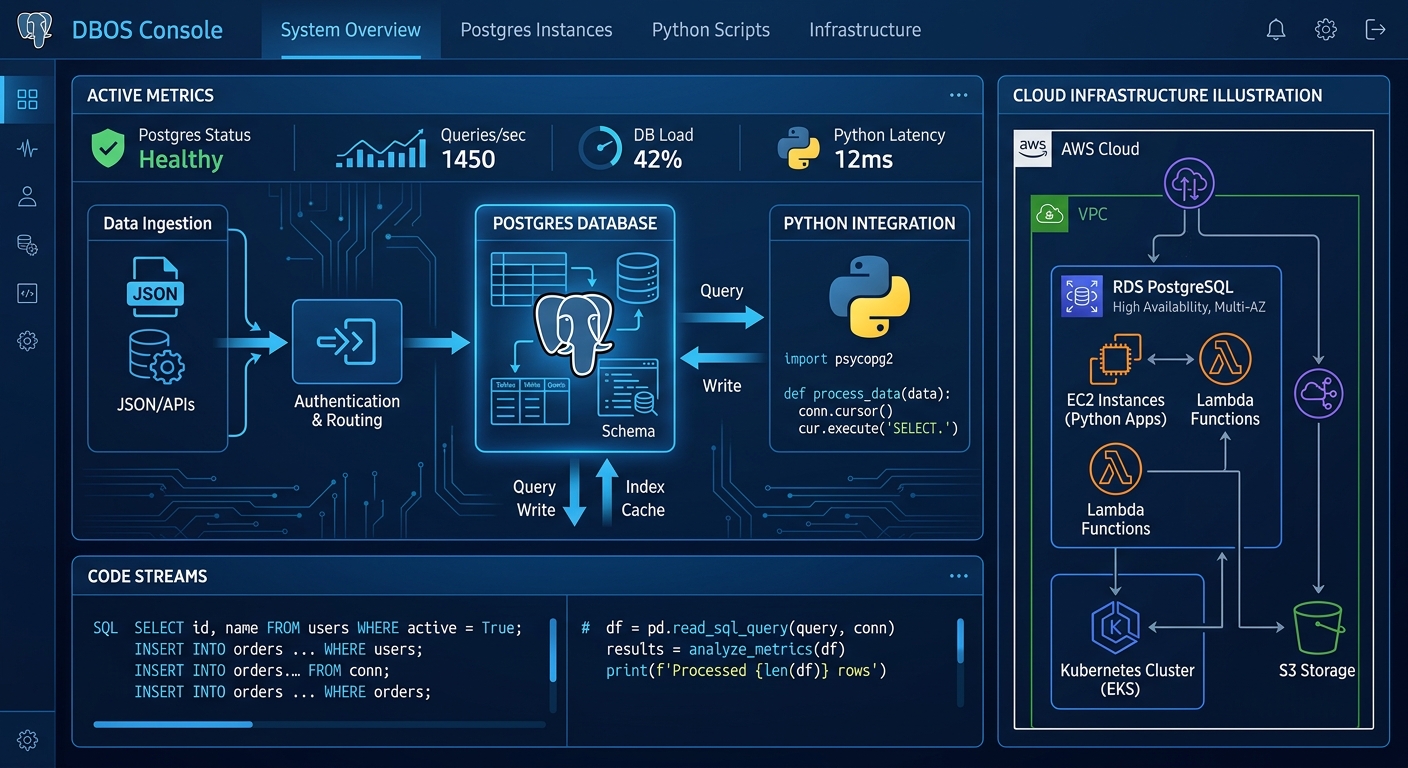
The idea is surprisingly elegant: every operation in your system is already writing to Postgres — orders, users, inventory changes. DBOS reads the Postgres transaction log to drive workflows. You don’t need a separate message queue, event store, or custom infrastructure. Your database becomes both your data store and your workflow execution engine. The operational footprint drops significantly because you’re not running a separate system — you’re using something you already have.

Getting started is straightforward if you’re already on Postgres. You write Python functions, point a config at your database, and decorate individual steps as retryable, inspectable workflow nodes. Each step’s input and output are logged. Each step can be individually replayed without re-running the entire workflow. Failure modes become reproducible instead of requiring full restarts.

The use case I keep coming back to: AI agent task orchestration. If your agent needs to search for information, read a document, write output, and verify correctness — DBOS wires those steps together with automatic retry and full visibility into each step’s execution. You get observability into agent reasoning without a separate tracing system. When something goes wrong, you can see exactly which step failed and what the inputs were, which is the difference between debugging and guessing.

The operational appeal is real: teams that couldn’t justify Temporal’s infrastructure overhead might find DBOS fits within what they’re already running. The constraint is that it’s tightly coupled to Postgres, which is a strength in some ways (simplicity, data locality) and a limitation in others (you can’t easily move workflows to a different database). Performance-sensitive real-time scenarios with very low latency requirements may not fit the model well, since transaction log reading introduces latency that direct function calls don’t have.

It’s early, and the ecosystem is still building out. But for teams already on Postgres who want workflow capabilities — particularly AI agent orchestration — without the operational overhead of a separate system, this is worth a half-day of exploration time. The gap it’s filling is real, and the approach is more elegant than I’ve seen from similar tools.


Related Articles:

  1. Big Tech Is Quietly Ditching Nvidia — and Building Its Own Future
  2. OpenAI Bidirectional Voice Mode Lets You Actually Interrupt ChatGPT
  3. NousCoder-14B Is the Open-Source Coding Model That Arrived at the Right Time
  4. Forget the Benchmarks. The Real AI Race Is in Daily Cron Jobs
  5. How Power Users Actually Run Hermes: The Infrastructure Behind the Chatbot
  6. Krea 2 Turbo: The Fastest Open-Weights AI Image Generator at 2 Seconds Per Image

Tags:

ai-agentsai-toolsai-image-generationai-newsai-hardwareai-productivity
Author

Forker

Follow Me
Other Articles
Previous

The Open Source AI Singularity Was Supposed to Be Here by Christmas. It’s Not.

Next

Ideogram 4 Open Source: The AI Image Generator That Finally Matches GPT-Image and Midjourney

No Comment! Be the first one.

Leave a Reply Cancel reply

Your email address will not be published. Required fields are marked *

Latest Articles

  • Codex + OpenMontage Made Me Throw Out My Editing Software
  • 10 Open Source Scrapers That Do What Paid APIs Do
  • Hermes Agent v0.20.0: It Finally Learned to Talk Back
  • PhotoGIMP: How I Turned GIMP into a Free Photoshop Clone
  • 8 Gemini Notebook Prompts That Actually Work
  • How I Built My Own Automation Hub (And the Problems That Nearly Stopped Me)
  • Hermes v0.19.1 Quietly Fixes the Frictions That Annoy You Most
  • Five AI Agents, One Trading Decision: The Architecture Behind the 95K Stars

Categories

  • DeepSeek
  • Qwen
  • GLM
  • Kimi‌
  • Codex
  • Hermes
  • Openclaw
  • Claude Code
  • Gemini
  • Hunyuan
  • China AI
  • AI Agent
  • AI Prompts
  • AI Tool Reviews
  • AI Guides
  • AI News

Tags

AI agent collaboration AI agent memory AI benchmarks AI coding assistant memory AI coding tools AI coding workflow AI context window AI dashboard AI deployment AI implementation AI models AI orchestration AI policy AI privacy AI security alternative AI hardware Anthropic ChatGPT Claude Claude coding Claude Tag Copilot cybersecurity developer tools FLUX GitHub code diagram knowledge management LLM LLM security local-first long context AI Midjourney Notion alternative Obsidian OpenAI OpenClaw open source open source AI persistent AI prompt-injection real AI coding agents Slack AI spreadsheet automation US government AI vetting workflow engine

About

Latest AI industry news and trend analysis, as well as tool evaluations.

Quick Links

  • About AIForker
  • Contact
  • How We Test
  • Privacy Policy
  • Tags

Category

  • AI NEWS
  • AI TOOL
  • AI GUIDES
  • CHINA AI
  • AI PROMPTS
Copyright2026 — AIForker.com. All rights reserved.