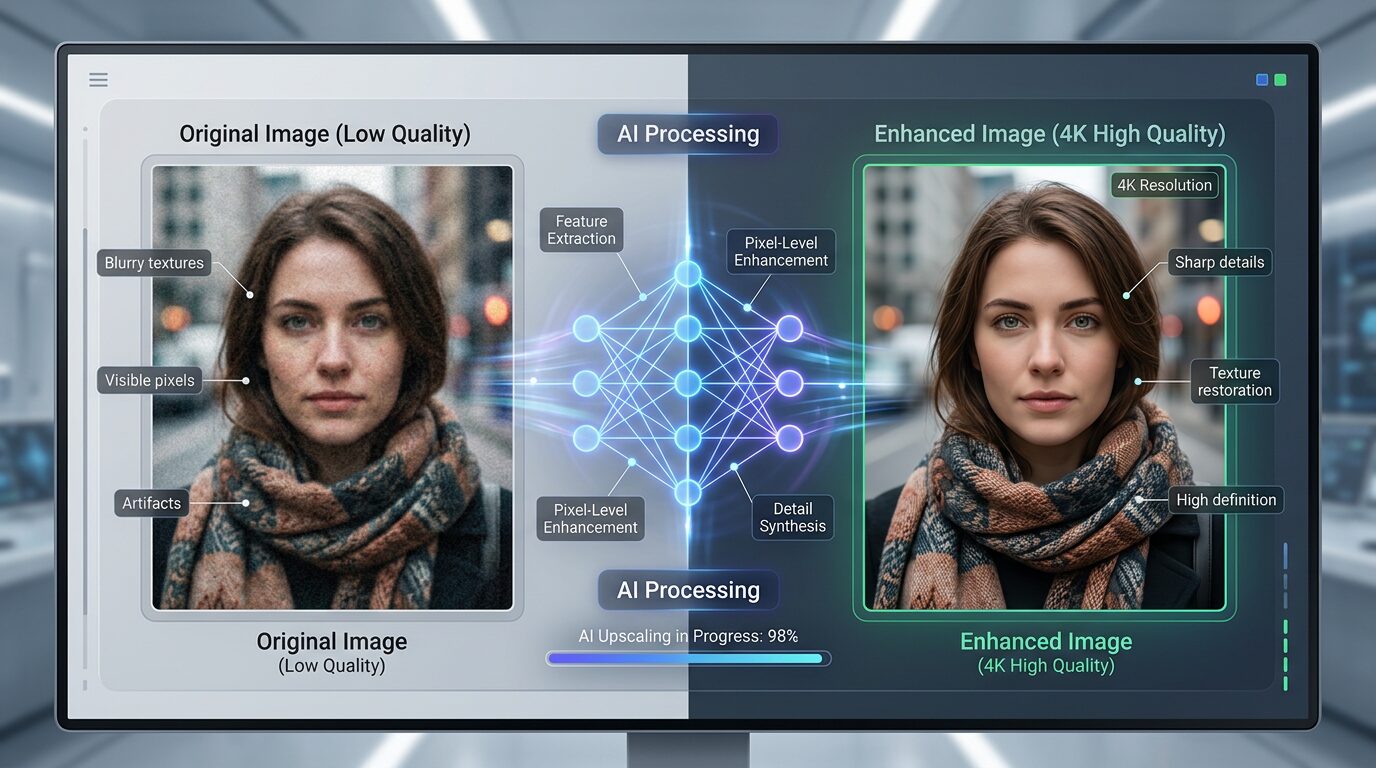
4 Steps to 4K: This AI Image Model Makes Super-Resolution Actually Usable
Image upscaling used to be a chore. You fed a blurry photo into a tool, waited for it to hallucinate some details, and hoped the result didn’t look like a painting. If you wanted to edit the upscaled image — change a color, fix a detail — you started over from the original low-resolution source and re-ran the whole pipeline. It’s a workflow built around a fundamental limitation: most super-resolution models are one-way streets. They take low-res input and produce high-res output. They don’t give you a seat at the table during the generation process.
A new model called PiD — Pixel Diffusion — is challenging that assumption with a different architectural bet. Rather than treating upscaling as a separate post-processing step, PiD unifies image decoding and super-resolution into a single process, and it does it in just four steps. The result is a model that’s simultaneously faster, more controllable, and better at preserving fine details than the multi-step pipelines that have dominated the field.
To understand why PiD matters, you need to understand how current image generation and upscaling pipelines typically work. Modern AI image generators like Stable Diffusion work by denoising — they start with random noise and gradually refine it into an image. To get a high-resolution output, you usually generate at a lower resolution first, then pass the result through a separate upscaler. Each step adds inference time and can introduce inconsistencies between the base image and the upscaled version. The upscaler doesn’t know what the generator was trying to produce — it just guesses at what high-frequency details might belong.
PiD’s approach: use a pixel-level diffusion process that runs directly at the target resolution, eliminating the handoff between a generation model and a separate upscaler. Instead of generating a low-res image and then upscaling it, PiD generates the high-res image directly — but does so efficiently enough that it only needs four denoising steps to produce 4K-quality output. That’s roughly six times faster than comparable methods that require 24 or more steps for similar quality.
The four-step claim isn’t a benchmark trick. PiD’s architecture uses a different sampling strategy than standard diffusion models — one designed for coarse-to-fine generation where each step contributes meaningful resolution detail. The result is practical for interactive use cases that were previously out of reach for diffusion-based super-resolution.
In demo applications, users upload a low-resolution image and receive a 4K result in seconds. The editing workflow is where the approach gets particularly interesting: because PiD processes the image directly at full resolution, it can accept region-level editing instructions — change the color of an object, add an element, fix a specific artifact — and propagate those changes at full resolution without re-running a separate pipeline. That kind of in-process editability has been one of the holy grails of AI image processing.
Six times faster doesn’t sound dramatic until you think about what you can do at that speed. Interactive image enhancement in a creative tool becomes feasible. Real-time upscaling for live video streams becomes plausible. Batch processing of product images at e-commerce scale becomes economical.
Current diffusion-based super-resolution typically requires 20 to 50 steps to achieve a clean 4K output without obvious artifacts. At roughly 1-2 seconds per step on a standard GPU, that puts inference time between 20 and 100 seconds per image. PiD’s four-step pipeline produces comparable quality in under 10 seconds on the same hardware. For applications processing images at scale, that’s a fundamental shift in what’s economically viable.
Speed gets attention, but the controllability angle may matter more over the long run. Traditional upscaling is fire-and-forget: you put an image in, you get a better image out, and any subsequent edits require starting from the original source. PiD’s single-process architecture means the model maintains a richer representation of the image throughout the generation process, which makes it more amenable to targeted modifications.
In practical terms: you can make high-resolution edits to specific regions without degrading the rest. Change the texture of a surface, adjust lighting on a specific object, remove an unwanted element — and the changes render at full 4K resolution as part of the same process rather than as a secondary pass that risks introducing inconsistencies. For creative professionals who need both quality and control, this combination has been difficult to get in a single tool. PiD looks like one of the first serious attempts at delivering both.