Turn Any Photo Into a 3D Model: The Tech That’s About to Change E-Commerce
3D product visualisation has always been expensive. You needed a studio, specialised equipment, and skilled artists who understood both the geometry and the rendering pipeline. A single high-quality product render could cost hundreds of dollars and take days. That’s fine for a Fortune 500 company launching a flagship phone. It’s completely impractical for a mid-size e-commerce brand trying to put 3D views on 500 product pages.
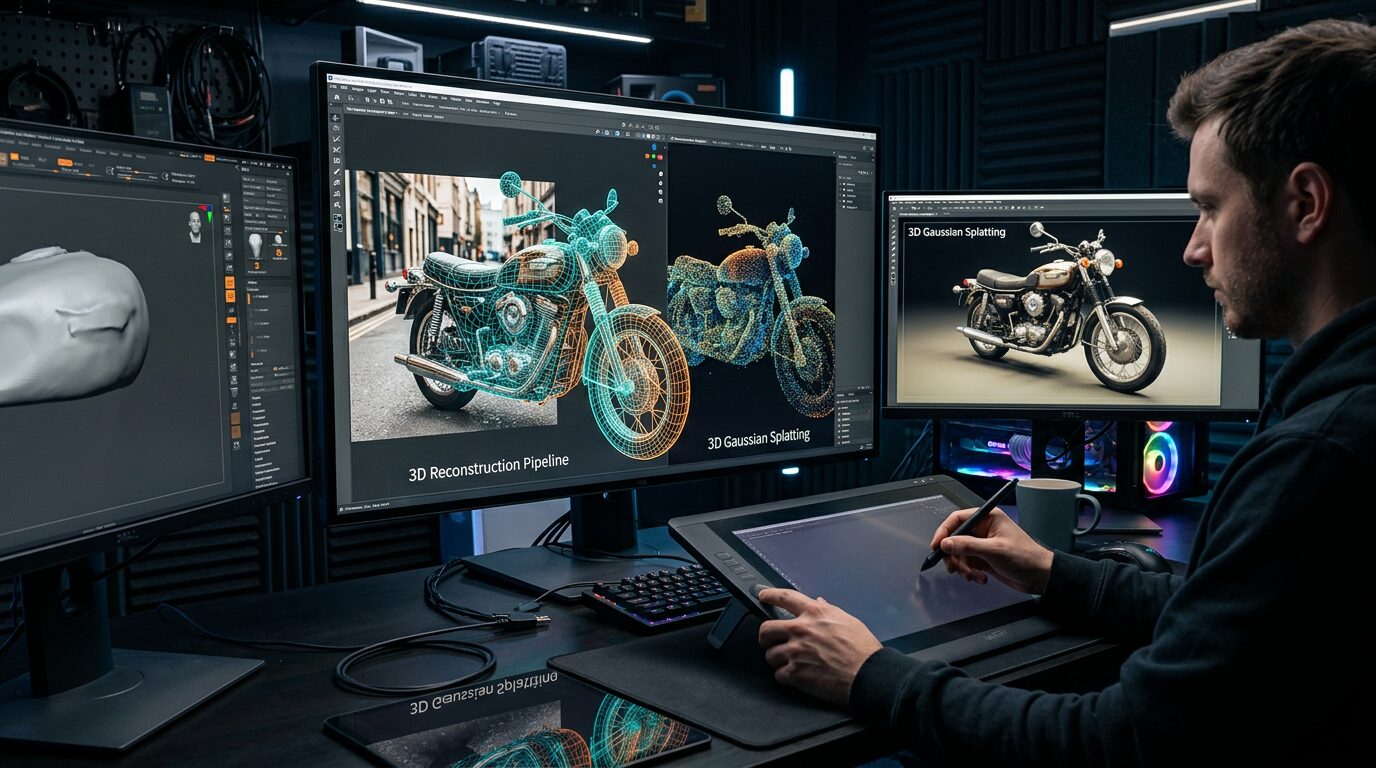
TripoSplat is a system that converts a single photograph into a detailed 3D model using Gaussian splatting — a rendering technique that represents objects as collections of 3D Gaussian functions rather than traditional polygon meshes. The practical result: upload one image, get back a usable 3D asset in minutes. No studio. No specialised knowledge. No multi-day turnaround.
Why This Is a Bigger Deal Than It Sounds
The barriers to 3D content have always been upstream. You needed to either photograph an object from many angles — typically 20 to 50 — or use 3D modelling software to build a representation from scratch. Both approaches are time-consuming and require expertise that most product teams don’t have in-house.
TripoSplat’s single-image approach works because Gaussian splatting can reconstruct 3D structure from fewer viewpoints than traditional photogrammetry. It doesn’t need a complete orbit of images — it can infer depth and structure from partial information and fill in the gaps intelligently. The result isn’t always perfect (complex geometry with fine details remains challenging), but for a large proportion of e-commerce products — bottles, boxes, shoes, furniture — it’s already good enough for a genuinely useful 3D preview.
For online retailers, this changes the economics of 3D product visualisation fundamentally. A brand that couldn’t justify the cost of professional 3D renders for hundreds of SKUs can now generate basic 3D assets at scale. The customer experience benefit is real: multiple studies have shown that 3D product views reduce return rates and increase conversion, but the adoption has been limited by production cost. That constraint is now lifting.
The Gaming and Virtual World Angle
E-commerce is the obvious use case, but it’s not the only one. Game studios have been using photogrammetry to create environmental assets for years, but the process requires careful photography under controlled conditions. TripoSplat-style approaches work with less controlled inputs — a photo taken in natural light, a screenshot from an existing game, a historical image — and reconstruct usable 3D geometry from them.
For virtual world builders, this is a significant productivity unlock. Creating 3D assets has historically been a specialised skill that acted as a bottleneck in world-building pipelines. When any photograph can become a 3D model with minimal processing, the bottleneck shifts to curation and creative direction — which is exactly where human creativity adds the most value.
Where It Still Struggles
Being honest about limitations matters for credibility. TripoSplat-style reconstruction still has trouble with transparent objects (glass, water), extremely thin structures (hair, meshes), and highly reflective surfaces. These are known hard cases in 3D reconstruction that the technique hasn’t fully solved. A shoe? Easy. A glass chandelier? You’ll need traditional methods for a while longer.
But the proportion of products where it works well is already large enough to make this a genuinely transformative tool for any team that works with physical products at scale. The question for product managers isn’t whether this technology is ready — it’s whether your team has the skills to integrate it into your workflow before your competitors do.