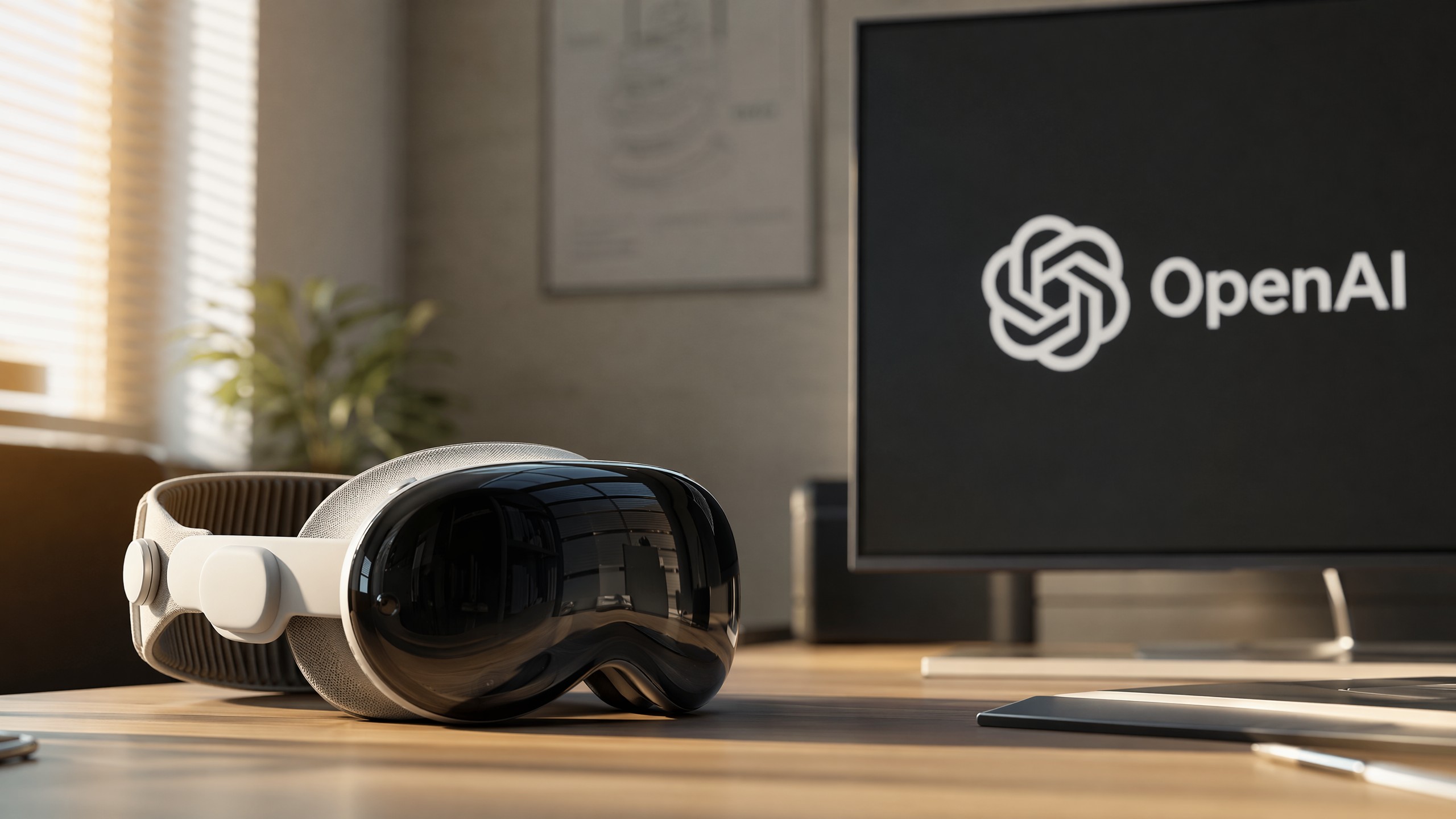
Apple’s Vision Pro Hardware Chief Just Defected to OpenAI. Here’s Why That Matters
Paul Meade spent years making Vision Pro happen at Apple. He was the guy who turned Apple’s mixed reality headset from a joke into something people actually wear in public without looking completely ridiculous — which, given Apple’s design standards, is a genuinely hard engineering problem. Spatial computing. Eye tracking. Hand gesture recognition at scale. The thermal management that keeps a powerful computer comfortable against your face for hours.
Now he’s leaving for OpenAI’s hardware team.
The news dropped Saturday, and it landed the way these things usually do in tech: a quiet Reuters piece that most people skimmed past on their weekend. I almost did too. But sit with it for a minute, and it gets interesting.
Why OpenAI Is Finally Serious About Hardware
OpenAI has been flirting with hardware for a while. The Jony Ive rumors. The robotics project that never quite materialized. Sam Altman has been clear that he thinks the future of AI isn’t just software — it’s devices that have AI baked in at a fundamental level.
But there’s a difference between saying you want to build hardware and actually hiring the people who know how to do it. Vision Pro isn’t just another tech product. It’s arguably the most ambitious consumer hardware project of the past decade — a spatial computer that required solving problems in optics, thermal engineering, sensor fusion, and human-computer interaction that nobody had solved at this scale before.
Meade is one of the few people who actually shipped something like that.
So what does OpenAI want to build? Here’s my guess, and I want to be clear it’s a guess: I don’t think they’re going for another VR headset. The VR/AR market is already crowded with Apple’s own device, Meta’s Quest line, and a graveyard of startups that tried and failed. The interesting play isn’t competing in that space — it’s taking the lessons of spatial computing and applying them to something new.
Maybe it’s a screen-less device. Maybe it’s ambient computing. Maybe it’s something nobody’s announced yet and won’t for another two years. The point is that OpenAI just acquired talent that can actually execute on hardware ambitions, not just talk about them.
The Timing Isn’t Random
This move comes a few weeks after OpenAI’s Jalapeño chip news — their custom silicon built with Broadcom to reduce dependence on Nvidia. That’s software and infrastructure. Meade is the hardware piece of the puzzle. When you put those together, you’re looking at a company that is systematically building out every layer of the stack: models, silicon, and now physical devices.
The common thread is control. If you’re building AI that’s supposed to be everywhere — in your work, your home, your devices — you don’t want to be dependent on other people’s hardware, other people’s chips, other people’s distribution. Apple understood this with the iPhone. OpenAI seems to be reaching the same conclusion.
What This Means for Apple’s Hardware Future
For Apple, losing Meade isn’t catastrophic. They’re Apple — they have deep benches and can absorb individual departures. But it’s a signal. The Vision Pro project has been one of Apple’s most ambitious hardware efforts, and the fact that its hardware lead is choosing to go to an AI company rather than stay and iterate on Vision Pro 2 says something about where the momentum is.
Spatial computing is still a solution looking for a problem. The use cases that justify wearing a headset for hours a day haven’t materialized yet. Meanwhile, AI is everywhere and growing faster than any other area of tech. If you’re a hardware engineer who wants to work on the next big thing, the math is getting easier to do.
I’ve been thinking about this since the news broke. My first reaction was that it’s just executive talent flow — normal in tech, not worth overthinking. But the combination of the Jalapeño chip news and now this suggests OpenAI is building something specific. They’re not just hiring AI researchers anymore.
The question now is what that something is. I’m genuinely curious to see what OpenAI announces next — and more importantly, whether it can ship anything close to as polished as Vision Pro. Because that’s what Apple really knows how to do, and it’s the thing that matters most for hardware that people actually want to wear.
I guess we’ll find out.