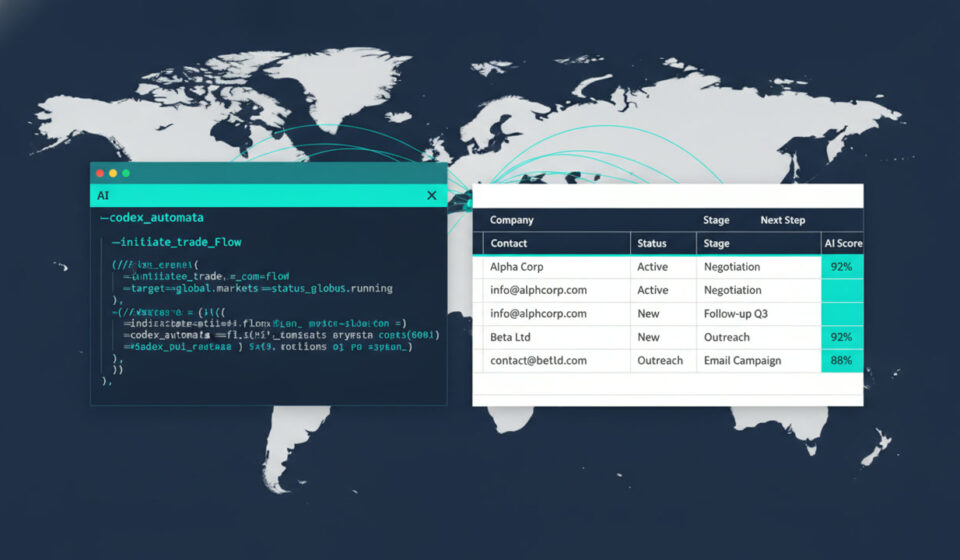
How to Build a Foreign Trade Business Using Codex
Most people getting into foreign trade are not stuck on translation. They are stuck on the harder parts: finding buyers, verifying decision-makers, writing emails that do not sound like spam, and knowing what to do after hitting send.
A few years ago, all of that required a team. One person hunting for leads, one preparing materials, one setting strategy. You do not need that team anymore.
AI will not just write your emails. It will let you build a system that handles lead generation the same way every single day.
That is what this guide is about.
The Real First Step
The most common mistake new exporters make is front-loading the infrastructure. Register a company first. Build a website. Buy customs data. Run ads.
None of that is where you start.
The actual first step is simpler and genuinely difficult: can you find real buyers and determine whether any of them might actually purchase what you are selling?
Take pet clothing as an example. Do not broadly search “pet buyer.” Break the market down first:
- Pet product wholesalers in the United States
- Pet chain retail stores
- Independent boutique pet shops
- Amazon pet brand sellers
- Pet product importers
- Pet gift custom companies
- Dog training facilities and grooming salon chains
Once you segment like this, your direction becomes clear.
A wholesaler cares about price stability and supply consistency. A boutique shop cares about design aesthetic and small batch flexibility. A brand seller cares about OEM and ODM capabilities. An importer cares about certifications, packaging, and delivery timelines.
The segmentation itself is the strategy. Codex helps you build it out systematically rather than guessing.
The Four-Point Verification Framework
Most lead generation ends with a list that looks good but does not convert. Either you cannot make contact, or the person is not a buyer.
A real lead passes four checks:
Does the company actually exist? Check their website, Google Business profile, and social media activity.
Is their business actually relevant? Look for evidence they sell similar products, have new arrivals, or have import needs.
Is your contact person accurate? Priority goes to Founder, Owner, Buyer, Purchasing Manager, or Category Manager. Skip info@ and sales@.
Can you actually reach them? LinkedIn, WhatsApp, and contact forms all go into the same sheet.
Build a sheet that tracks all four in one place. Most people build the sheet and never touch it again. The value only shows up if you open it every morning.
The Trade Lead Sheet That Actually Gets Used
What belongs on the sheet is simple: company name, what they do, who the buyer is, how to reach them, and whether you already tried.
The other fields get filled in as you go.
What matters is that every morning you open the same sheet, to the same place, and know exactly what to do today.
Not what you might do. Not what you thought about doing last week.
What you are doing today.
Most people start with a clean spreadsheet and end with an abandoned one. The ones who get results use the same sheet every single day.
What kills foreign trade businesses is not lack of leads. It is leads scattered across browser tabs, WeChat, spreadsheets, and email inboxes, with everything stored in memory.
Memory fails. Leads get lost.
Why Mass Emails Fail
If you are sending the same outreach email to every pet product buyer on your list, you are probably getting ignored.
A wholesale pet supplier and a boutique pet shop do not care about the same things.
A wholesaler wants to hear about stable supply, price tiers, and low MOQ. A boutique wants to hear about design aesthetic, small batch orders, and seasonal lines. A brand seller wants to hear about OEM and ODM capabilities, packaging customization, and speed to market. An importer wants to hear about compliance documentation, quality control processes, and bulk delivery track record.
One email template cannot serve all of those conversations well.
Codex can analyze content from a prospect’s website and generate outreach messages that feel specific to their business.
What makes outreach work is reading a prospect’s website and writing something that sounds like you did the reading.
Open their Amazon page or brand website. Identify two or three specific product lines they carry. Reference those in the opening line.
That single adjustment changes reply rates.
The Follow-Up Sequence
Most people send one email and stop when they get no reply. That is normal in international trade. Silence does not mean disinterest.
Plan for at least three rounds of follow-up.
The first message establishes the connection and explains who you are and what problem you solve. The second adds value by offering a product direction, a best-seller, or a low-risk trial option. The third reduces decision pressure by proposing a very small action.
When a prospect responds, classify the reply immediately. Are they asking for a quote? Requesting a catalog? Inquiring about MOQ?
Each category has its own response playbook. Having those ready before you send the first email is what separates systematic exporters from reactive ones.
Why Codex Over ChatGPT Alone
The reason Codex fits this workflow better than ChatGPT alone is that Codex operates in your terminal and can interact with your files, spreadsheets, and external tools in a single session.
You can ask it to build the lead sheet, generate keyword sets for each customer type, draft outreach templates, and set up follow-up reminder sequences without switching between different applications.
For someone starting from zero, the practical sequence looks like this:
Define your product category. Use Codex to generate a segmentation map of your target market. Build the lead sheet with all four verification layers. Draft three outreach templates, each tuned to a different customer type. Set up a follow-up sequence with specific triggers. Then execute, track results, and let the data tell you which customer segments actually convert.
The entire point is removing the parts of foreign trade that depend on memory, instinct, or luck, and replacing them with something you can run the same way every week.
That is the real promise of using AI in export trade. Not making the work disappear, but making it repeatable.