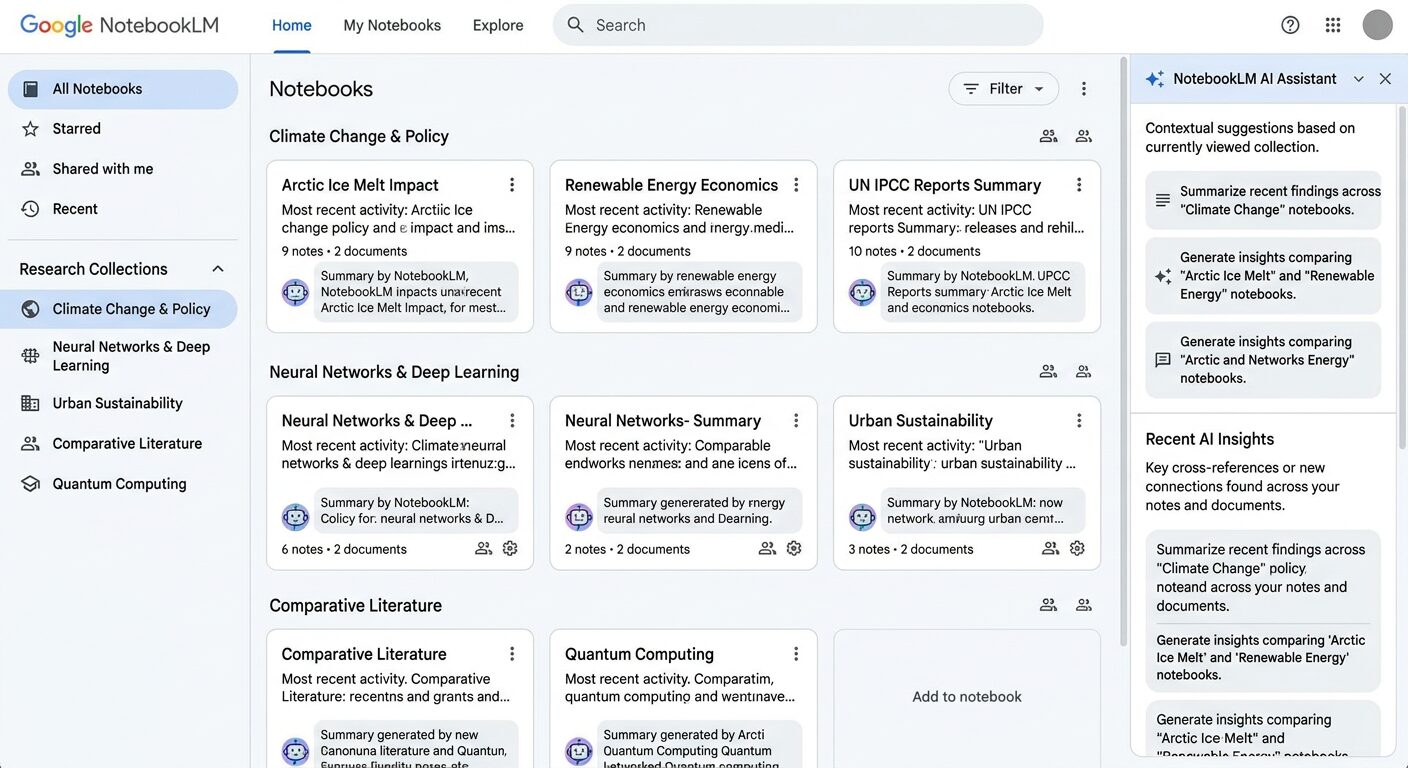
Google NotebookLM Gets Collections: Finally a Way to Organize Your Research
Google NotebookLM has been one of the more genuinely useful AI research tools to come out of Google Labs. The Audio Overviews feature alone — turning your research documents into AI-generated podcast discussions — has made it popular with researchers, students, and writers who absorb information better by listening than reading. Now Google is adding Collections, a way to group multiple notebooks under a single heading.
Why Collections Matter
NotebookLM’s core workflow is built around individual notebooks. You upload sources to a notebook, ask questions, generate summaries. But researchers rarely work on just one topic at a time. The ability to group related notebooks together — all your sources on a given project, or all research related to a specific client — makes the tool practical for actual research workflows rather than one-off queries.
The Collections feature is straightforward: create a collection, drag notebooks into it, access everything from a single view. It’s organizational infrastructure rather than a new AI capability.
The Literature Review Matrix: A More Interesting Addition
The more compelling new feature is the Literature Review matrix, still in testing. For researchers managing large numbers of sources, the matrix provides a grid view that shows uploaded sources in relation to each other, with AI-generated summaries of what each source contributes and how they relate. It’s designed for the research phase before you start writing, helping you understand what you have and where the gaps are.
For someone synthesizing information from dozens of papers, the matrix view could replace a manual process of notes and spreadsheets that’s tedious and error-prone.
What This Means for Research Workflows
NotebookLM has always been strong at the individual source level. Collections and the matrix take it toward being a research management platform — something that can handle the organizational complexity of serious research projects, not just one-off document Q&A.
The target user is someone doing literature reviews, building argument frameworks, or managing complex multi-source research projects. If that’s your workflow, these features make NotebookLM significantly more practical as a primary tool rather than a supplementary one.
Google’s AI Research Stack
NotebookLM sits in a growing portfolio of Google AI research tools that includes Gemini, NotebookLM’s underlying model, and various Workspace integrations. The direction is clear: Google wants to own the research and knowledge work segment, positioning against tools like Notion AI, Obsidian, and generic ChatGPT usage. Collections and the matrix fit that strategy.