Your AI Prompts Need to Become Skills. Here Is How.
You have probably been there. You ask AI to write a client brief, it comes back decent. You try again with a new client, it falls apart. Third project, the client sends extra materials and you have to re-explain everything from scratch.
The problem is not the AI. The problem is that you are having a conversation when you should be running a system.
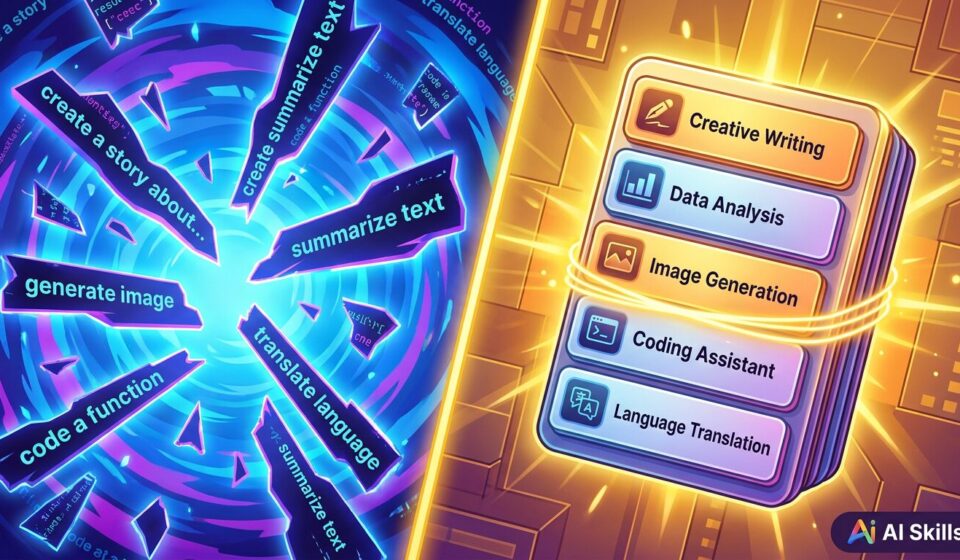
The difference between an AI power user and someone who keeps hitting a wall comes down to one move: stop writing prompts, start building Skills.
A prompt is a one-off instruction. “Write me a post.” It might work once. It will not work consistently across clients, topics, or formats.
A Skill is a structured workflow. Think of it as an SOP for AI. When a client submits materials, the workflow already knows what to check, in what order to process it, what good looks like, and what format to deliver.
The key components of any reusable Skill are five: scenario, inputs, steps, quality gates, and output template.
Once you have these five elements documented, you can hand the Skill to any AI tool, any client, or any team member and get consistent results without re-explaining yourself every time.
Here is the actual construction process, using a real example of turning a recurring freelance task into a repeatable workflow.
Start narrow. A Skill that tries to do everything does nothing well.
Specify exactly what situation this handles. For example: a Skill that optimizes location-based content for small businesses on social platforms. That is specific enough to be reliable and broad enough to be useful.
Define what the client or user must provide before work begins. Common requirements include: target platform, core selling points, authentic experience notes, price range, and any claims that cannot be made.
If any required input is missing, the AI must ask before generating anything. Skipping this step is where most people lose control of quality.
Do not let the AI guess the order of operations. Be explicit.
A typical content workflow might run: identify the target audience first, extract genuine selling points from the provided materials, generate headline directions, write the body copy, then produce a pre-publish checklist.
When sequence is undefined, the AI produces results that look like generic AI output, because they are.
These are the standards that determine whether the output is acceptable. For a content workflow, relevant gates might include: headlines are specific and concrete, body copy references real user experience, no fabricated prices or addresses, and the closing includes a clear call to action.
Without written standards, you have no basis for rejection and no way to explain to a client why a draft needs another round.
Specify exactly what gets delivered. A common structure: five headline options, one body post, three cover text variants, and one pre-publish checklist.
Clients who receive a structured deliverable package feel like they are buying a professional service. Clients who receive a raw chat transcript feel like they got a rough draft.
Here is a framework you can paste into any AI tool and adapt to your own workflow.
Skill Name: {Your Workflow Name}
Scenario: {What this Skill actually solves}

--- Inputs Required ---
- Material 1
- Material 2
- Material 3
If any required material is missing, ask before generating.

--- Execution Steps ---
1. Identify target audience and delivery goal.
2. Extract verified selling points from provided materials.
3. Generate initial draft following the output structure.
4. Self-review against quality gates and revise.
5. Deliver the final format.

--- Quality Gates ---
- Does this meet the client's stated goal?
- Does this use only verified material from the client?
- Does this avoid exaggeration, fabrication, or vague claims?
- Is the output ready to publish or deliver as-is?

--- Output Format ---
- Deliverable 1: {e.g. headlines, brief, table}
- Deliverable 2: {e.g. body copy, explanation, checklist}
- Deliverable 3: {e.g. acceptance criteria, next steps}
If you use automation tools like Make, Zapier, or n8n, this framework translates directly into a node sequence: receive materials, check for missing inputs, trigger AI generation, format output, notify for human review.
Saving a prompt instead of a workflow is the most common mistake. A prompt solves one instance. A workflow solves a category. The time investment is roughly the same, but the return is not.
Another common failure is skipping the input checklist. When clients send incomplete materials, the AI generates something anyway and you spend twice the time fixing it. Define required inputs upfront and enforce them.
No quality gates is another trap. If you cannot describe what good looks like in writing, you cannot hold the AI accountable to it.
Vague output format is a third issue. “Write something good” produces something mediocre. “Deliver five headlines, one body post, and a pre-publish checklist” produces something usable.
Over-scoping the Skill is the final pitfall. Start with one small, repeatable task. Turn “organize meeting notes into an outline” into a Skill before you try to build a universal assistant. Small wins build the habit.
This is where the investment in building a Skill pays off directly.
You can package Skills as consulting offerings. A basic engagement documents one specific workflow for a client. A standard engagement builds the Skill into a reusable template they control. A premium engagement adds a structured follow-through period where you iterate the rules against real client feedback.
The important shift is what you are selling. You are not selling a one-time prompt output. You are selling a reliable, auditable, reusable system that produces consistent deliverables.
Clients pay more for work that comes with built-in quality standards and a delivery format they can actually use, rather than raw AI output they have to edit themselves.
Do not try to systematize everything at once. Pick one task you have done three or more times recently.
Write down the fixed scenario: who needs this, in what context.
List the five or fewer inputs the client must provide. Write out the five or fewer steps you actually follow. Define three concrete quality gates. Specify the exact output format.
Then run one new instance using only the Skill documentation. If you can hand it a new set of inputs and get a consistent result without re-explaining the process, the Skill works.
The goal is not to write better prompts. It is to stop writing prompts entirely and start running systems.