Your AI Coding Assistant Has No Memory. Here’s Why That Matters
TL;DR
Every AI coding tool you’ve used has probably felt forgetful. Not because the model is bad, but because context windows and memory are fundamentally different things. A new essay from Sigilix makes this distinction precisely: context carries text, memory carries constraints. And the AI coding tools of 2026 still don’t know the difference.
The Problem Nobody Talks About
You’ve been there: you ask an AI coding assistant to fix something, and it suggests a pattern you already rejected three weeks ago. You explain why it won’t work, it agrees, and you move on. Next session: same suggestion, same explanation, same frustrating loop.
The model isn’t broken. It’s working exactly as designed. It has no memory of your conversation.
This isn’t a criticism of any specific product. It’s a structural problem with how the industry has been building coding agents — and a small group of developers and researchers are starting to push back against the dominant paradigm.
Context vs. Memory: The Core Distinction
Sigilix, an AI coding assistant startup, published an essay that articulates the problem better than anything I’ve seen:
Context carries text. Memory carries constraints.
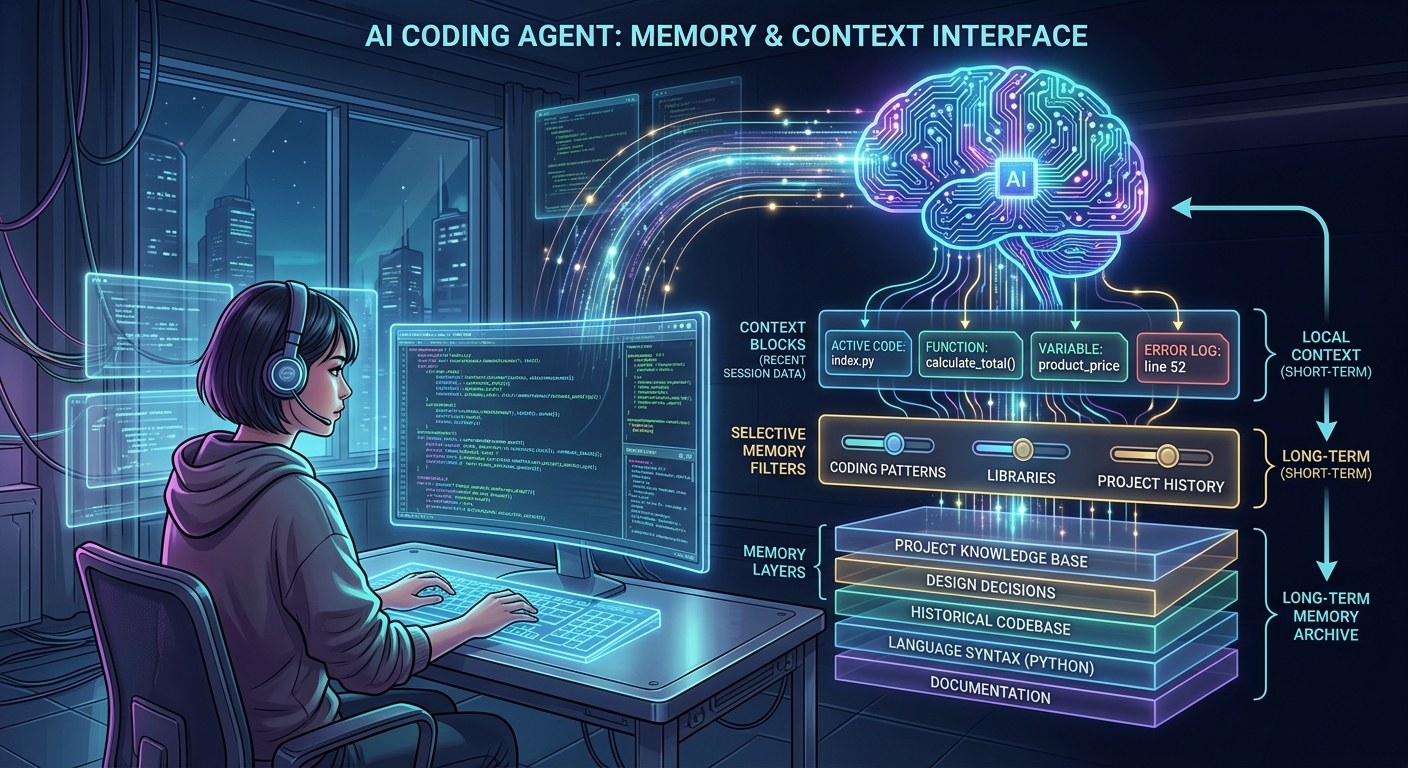
A context window — no matter how large — can hold more files, more logs, more discussion, more state. But it doesn’t know what to remember. It doesn’t know which findings were real and which were dismissed. It doesn’t turn last week’s correction into today’s constraint.
The difference matters because a coding agent needs both:
– Context-native agents pack the right files into the prompt. They can handle large prompts, but they treat every task like a fresh investigation.
– Tool-native agents can search, grep, and inspect. They feel more interactive, but they still start each task without knowing what happened in previous sessions.
– Memory-native agents work against a persistent backing layer that’s updated by reviews, comments, fixes, and previous sessions. Every interaction can leave evidence that future interactions can use.
The industry has been mostly building types one and two. Type three is still experimental.
Why Retrieval Isn’t the Answer
The obvious response: “Just index the repo and retrieve the relevant files.”
That’s a real improvement over pasting diffs into a chat window. It’s also not memory.
Retrieval answers: *”What text might be relevant right now?”*
Memory answers: *”What has this codebase already taught us that should constrain what we do next?”*
A retrieval system can show the model the current implementation. It won’t tell the model that the team already rejected a proposed pattern three reviews ago, or that a weird local convention exists because production depends on it, or that a finding that looks suspicious was previously proven to be a false positive.
This is why a coding agent can have great retrieval and still feel forgetful. It can find the right file and still ask the same question again. It can read the same helper and still propose the same wrong abstraction.
The Practical Consequences
If you’ve used AI coding assistants seriously, you’ve hit the edge of what context can do:
The repo is too large. A 500-file codebase can’t fit in any context window, even with summarization. The model has to choose what to include, and it doesn’t know what matters.
The convention is invisible. Your team has a convention — maybe around error handling, or test structure, or naming — that exists in no documentation. It’s just “how we do things.” A context-native agent has no way to know this exists.
The correction doesn’t stick. You spend ten minutes explaining why a pattern won’t work. The next session is suggested again. The model isn’t stubborn — it genuinely doesn’t remember.
The dead end gets revisited. Every team has explored a technical approach that didn’t work out. A context-native agent has no way to know this was already ruled out unless it’s in a document somewhere.
What’s Actually Being Built
Sigilix is building toward what they call “memory-native agents.” Their architecture has a persistent repo backing layer that gets updated by:
– Code review dismissals and corrections
– Comments that explain why something is done a certain way
– Fix records that document what was actually broken
– Issue triage that captures team decisions
– Agent session summaries
The key insight: most interaction data is noise after a few days. The useful parts are decisions, corrections, task state, conventions, dependency relationships, and proof. A memory layer has to be selective, or it becomes another pile of context to drown in.
The memory-native model doesn’t keep everything forever. It keeps what constrains future decisions.
What This Means for Choosing AI Coding Tools
If you’re evaluating AI coding assistants in 2026, ask a different question than the one vendors want you to ask.
Don’t ask: *”How large is the context window?”*
Ask: *”Does this tool remember what we decided last week?”*
For small projects with simple codebases, a large context window might be enough. The whole repo fits, the conventions are obvious, and the team is small enough that everyone knows what’s happening.
For large codebases with years of accumulated decisions, context windows are a band-aid. What you need is something that knows your team’s history — not just what’s in the files.
The best AI coding tool for complex, long-lived codebases in 2026 isn’t the one with the biggest context window. It’s the one that treats your team’s decisions as part of the problem.