AI’s Dirty Secret: Power Semiconductors Are the Bottleneck Nobody Is Talking About
Ask anyone following the AI boom where the real bottleneck is, and they’ll say GPUs or data centers. But underneath all that computing power, another shortage is starting to bite — and it might be harder to solve.
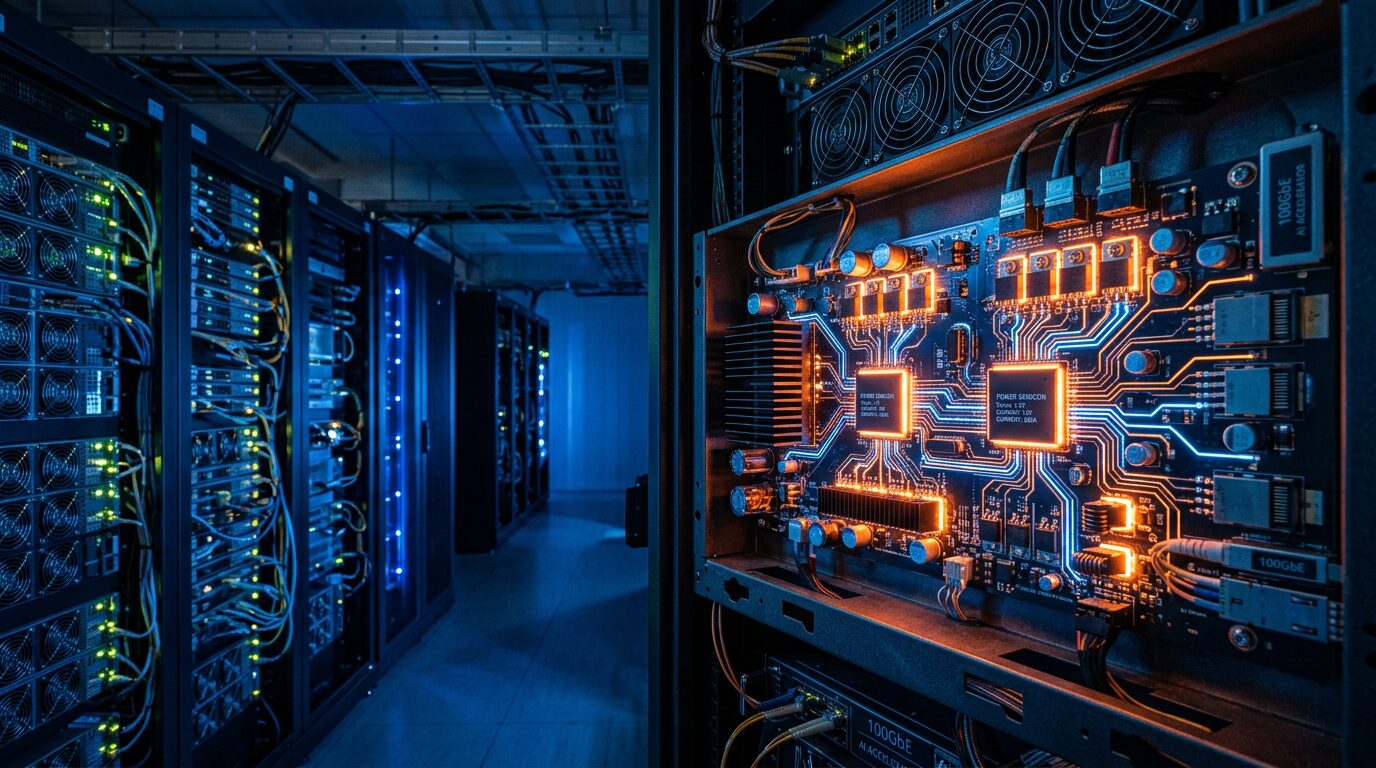
Power semiconductors regulate and convert electricity inside every server rack and data center. MOSFETs, IGBTs, SiC devices. They sit between the grid and the chip. Every conversion step, every voltage regulation event, every DC-to-DC conversion inside a server PSU depends on these components working efficiently. As AI workloads run at sustained high utilization rather than the bursty patterns traditional enterprise computing used to see, the stress on these components multiplies. The difference between a server running 30% utilization and one running 90% utilization isn’t linear in terms of power component stress — it’s closer to exponential.
A single high-end AI training cluster — the kind Google, Microsoft, and ByteDance are deploying by the thousands — draws electricity at a scale that would have been unthinkable for commercial computing a decade ago. A modern GPU server node can consume 6 to 10 kilowatts. Stack hundreds of them together, and you’re looking at facility-level power demands that rival small industrial plants. Not figuratively. Literally.
“Our AI-related power semiconductor orders are completely booked. We literally cannot keep up with demand.” That’s what one Chinese power device manufacturer told local media this week. The company, one of the few domestic producers with genuine mass-production capability for data center-grade power components, said its products have already entered the supply chains of multiple leading customers at scale. This isn’t a speculative shortage. These are orders that are already placed and can’t be fulfilled.
The current price increases are cost-driven, not speculative. Raw materials for power semiconductors — particularly silicon wafers and silicon carbide substrates — have risen sharply over the past 18 months. The structural driver is demand: AI data centers are locking up capacity years in advance, leaving traditional enterprise customers and industrial clients scrambling for allocation. The companies with existing supply agreements are in a better position than the ones trying to place new orders.
Smaller manufacturers without full IDM capability or deep ties to upstream substrate suppliers are being squeezed out. The era of commodity-grade power components at rock-bottom margins is ending in the high-performance segment AI needs most. This is consolidation happening in real time, driven by demand that isn’t going away.
Power infrastructure is increasingly a first-class constraint in AI deployment, not an afterthought. Hyperscalers are reportedly redesigning data center power architectures from the ground up — moving from traditional AC distribution to higher-voltage DC systems, stacking SiC and GaN components for efficiency gains, bypassing off-the-shelf UPS systems entirely in favor of purpose-built power trains. This is a multi-year infrastructure transformation, not a product decision.
Some analysts have started calling this the power wall — the point at which adding more GPUs to a cluster stops making economic sense because you can’t efficiently power and cool them. If true, it represents a fundamental constraint on the scaling trajectory the industry has been riding. GPUs get cheaper. Power infrastructure doesn’t get cheaper at the same rate. At some point the economics flip.
The irony: AI is simultaneously creating the demand and making the components harder to produce. The same compute boom driving semiconductor investment across the board is consuming power components faster than suppliers can add capacity — and building new fab capacity for power semiconductors takes years, not months. You can’t shortcut this one by spending more money.
For now, the AI industry is learning to live with higher power costs as a permanent line item rather than a temporary variable. The companies best positioned are those with long-term supply agreements, vertical integration, or both. For everyone else — smaller AI startups, enterprises building their own inference infrastructure — the message is clear: plan for power the way you’d plan for GPUs. Both are now strategic constraints.