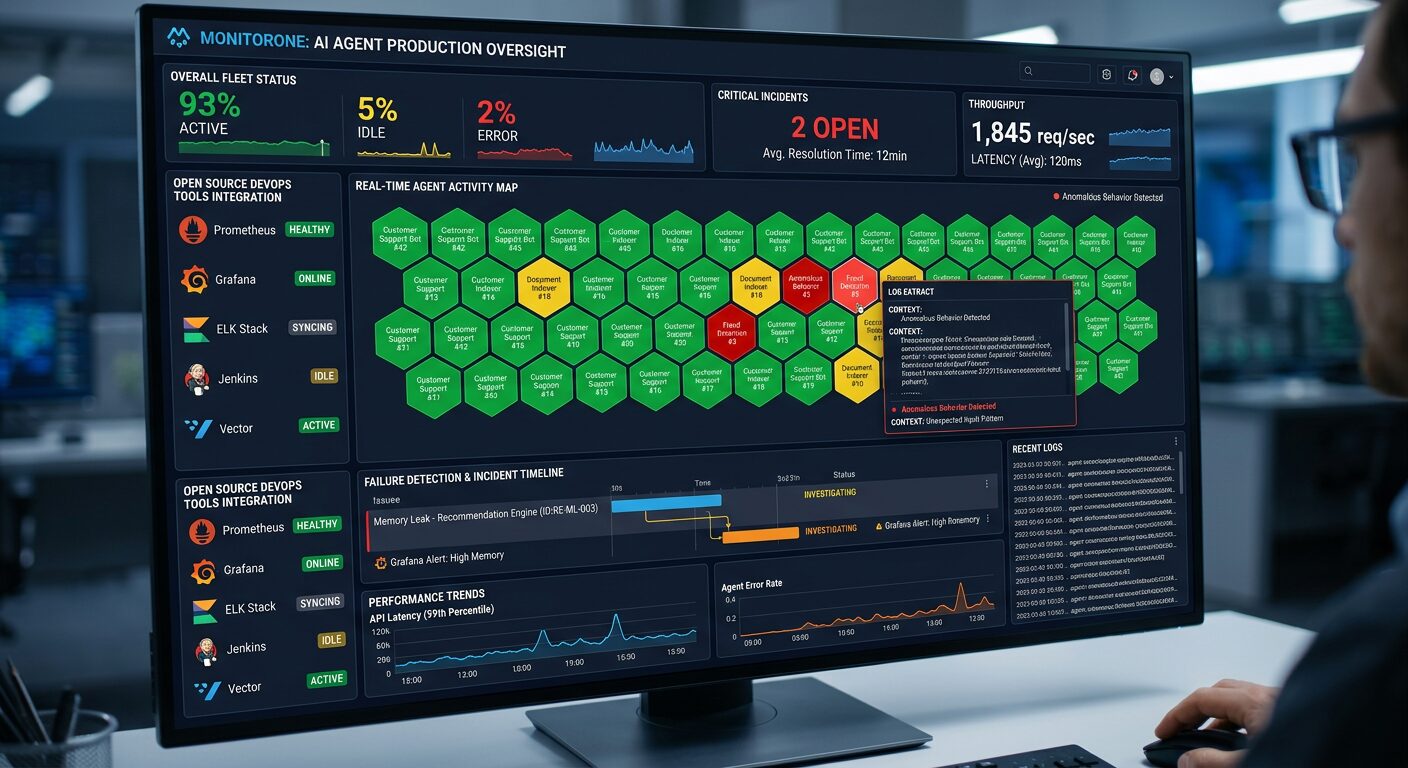
Latitude Wants to Be Datadog for AI Agents — and It’s Open Source
If you’ve shipped an AI agent to production, you know the moment I’m talking about: it’s live, and you have no idea what it’s actually doing.
Traditional monitoring was built for deterministic code. Logs, traces, metrics. That’s fine when you wrote something, and it does exactly what you wrote. AI agents don’t work that way. They take unexpected paths. They make reasoning errors that are hard to reconstruct. They fail after a sequence of steps that each looked fine individually. When something goes wrong, you don’t want the final output. You want the entire chain of thought and action that led there.
Standard application monitoring gives you logs, traces, and metrics. That works for code that was deterministic from the start. AI agents operate differently — their decision paths aren’t predetermined, and a failure in production often requires reconstructing a chain of reasoning that looked reasonable at each step. Traditional debugging tools weren’t built for this. You need to see everything: every model call, every tool invocation, every intermediate decision. When something breaks, you need a full replay, not a one-line error.
Latitude is building the instrumentation layer for that problem. MIT licensed, open source, self-hostable. Every model call, every tool invocation, every intermediate decision — captured and replayable. When something goes wrong, you get a full trace of what the agent actually did instead of guessing from the final output.
The ‘fix in editor’ piece is the part that actually matters for developer workflow. You’re looking at a production failure. You jump directly into the context where the agent was running, understand what happened, and push a fix. Compare that to traditional debugging where you’re reconstructing state from logs and guessing. For agentic systems, that’s not a nice-to-have. That’s the difference between debugging and guessing.
The open source bet is also a strategic one. If you’re building tooling for developers, being the Datadog of AI agents means being the standard. Being the standard means your format wins. That’s worth more than proprietary lock-in in a market that’s still figuring out what ‘good’ looks like. If your monitoring tool’s data format becomes the de facto standard, that’s a moat that survives any technical advantage a competitor might have.
For enterprises: self-host means data never leaves your infrastructure. No third-party API, no residency concerns. For teams building agents that handle sensitive data — customer support agents, legal research agents, anything that touches confidential information — that’s not optional. It’s table stakes.
The honest question is whether the market is ready for a standard. AI agents are still new enough that most teams are building their own internal tooling. A standard observability platform only matters when most teams have shipped enough agents to need one. We’re getting there. Not there yet.
But if you’re building agentic systems today and you’re not thinking about observability from the start, you’re going to have a bad time when something breaks in production, and you can’t figure out why. And in agentic systems, ‘something breaks’ doesn’t always mean the agent stops. Sometimes it means the agent keeps running and keeps doing the wrong thing confidently, for longer than you’d like, before you notice.