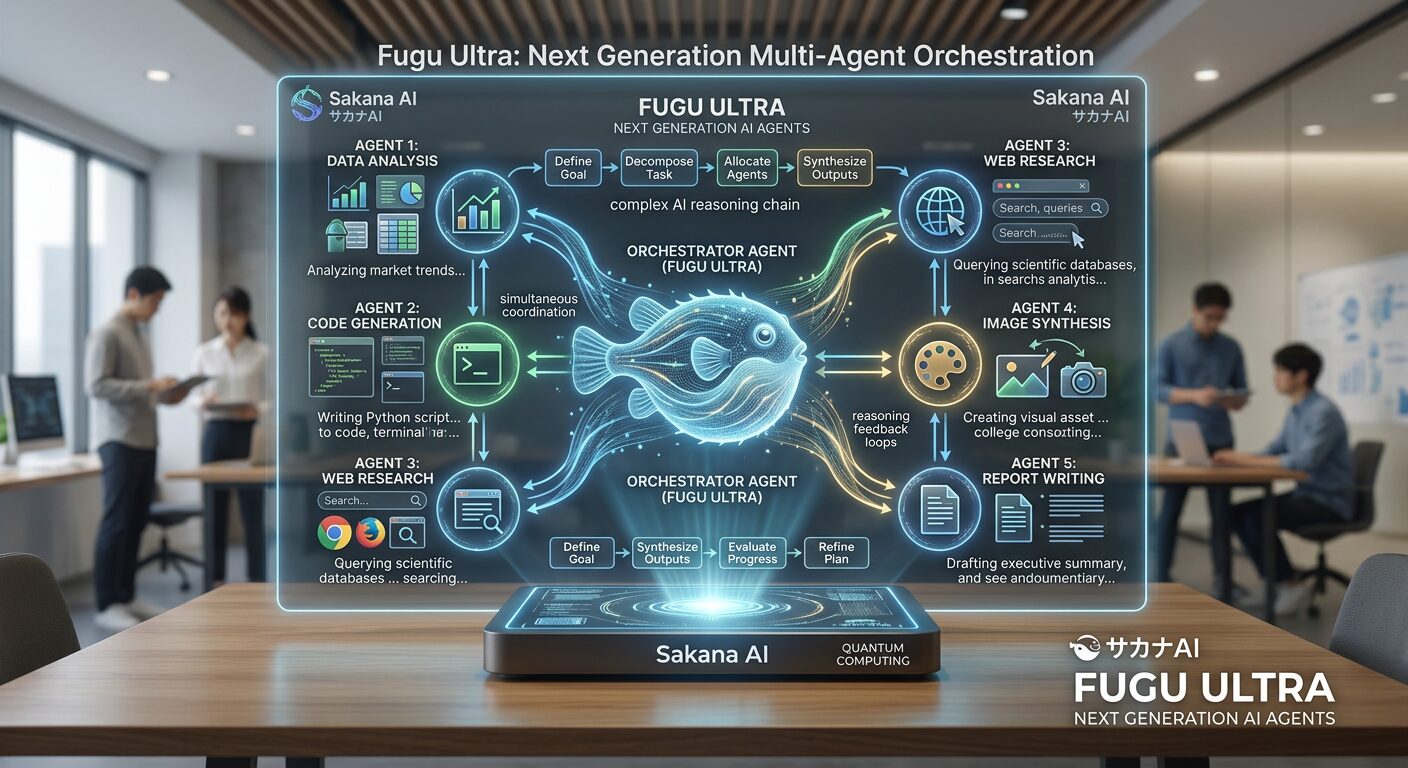
Sakana AI Fugu Ultra Routes Complex Tasks to the Right Specialist Model
A Tokyo-based engineer first mentioned Sakana AI to me in the context of foundation model research. Not as a footnote. In the same conversation as work coming out of Stanford. That was enough to make me pay attention.
Sakana is based in Japan. Fugu Ultra is their multi-agent orchestration system — not a chatbot, not a single-model API, but a routing layer that sends different tasks to specialized models and tries to keep the whole thing coherent. The idea is that no single model has to be good at everything. Fugu Ultra handles the coordination.
The concept sounds obvious when you say it out loud. The hard part is making it work without errors accumulating at every agent boundary. Context gets lost. The research model and the coding model disagree on assumptions. These are the problems that make most multi-agent systems fall apart in practice, and they are the problems Sakana is trying to solve.
They expose an OpenAI-compatible API. I tested this by pointing an existing codebase at their endpoint. Swapping the base URL took about ten minutes. There was no other code change required. That is the right kind of friction for a tool you are evaluating — low enough to try without commitment, structured enough to be serious about.
For single-step tasks, Fugu Ultra is the wrong choice. The routing overhead does not pay off when you just need one model to do one thing. Where it starts making sense is layered, multi-stage work: research that spans multiple sources and synthesizes findings, or a coding task that requires implementation and documentation in sequence. If your work is well-defined and single-stage, this adds complexity without benefit.
Sakana is not the only company working on multi-agent routing. But competing on OpenAI API compatibility from outside the US is a coherent market position. Early days. The benchmarks are published. I have not put it through serious production traffic. The architectural direction is worth watching.